Thursday, August 13, 2009


Tuesday, August 11, 2009
Netflix culture and values
Here's an interesting internal presentation from Netflix on their company culture and values.
Among other things, the presentation argues that in order to preserve a high level of freedom as the organization transitions from start up mode to large organization mode, the organization will actually hire more and more star performers. In other words, you maintain freedom by hiring more responsible people who are good performers. I don't see how that is practical. A ten employee company can easily hire 2-3 stars and increase head count by 20-30%. However, a 1000 employee company would need to find 200-300 stars in the market place in order to maintain its star ratio as it were. This seems quite hard to do.
Among other things, the presentation argues that in order to preserve a high level of freedom as the organization transitions from start up mode to large organization mode, the organization will actually hire more and more star performers. In other words, you maintain freedom by hiring more responsible people who are good performers. I don't see how that is practical. A ten employee company can easily hire 2-3 stars and increase head count by 20-30%. However, a 1000 employee company would need to find 200-300 stars in the market place in order to maintain its star ratio as it were. This seems quite hard to do.
Culture
View more presentations from reed2001.
Saturday, August 8, 2009
Monday, July 20, 2009
Argentina's peculiar coin shortage
For well over a year now, small change has been hard to come by there. Stores hang “No Coins” signs in their windows, and offer candies instead of change. Taxi-drivers round up—or down—to avoid giving up precious coins, while smaller merchants sometimes turn away business if you have only bills to offer them. The government has fined banks thousands of pesos for refusing to hand over coins, and, in October, the city’s subways became temporarily free when the booths ran short of change. For the average Bonaerense, everyday transactions now entail a complicated calculation of where coins can be acquired and when they will be needed.
More here
More here
Thursday, July 9, 2009
Tata Docomo's launch
Tata Docomo's GSM service is being launched in a very Web 2.0 way, with a Twitter page ,Youtube Channel , and a very 'social' website with user comments, page ratings, share links for facebook etc. I see  a very strong brand in the making - one that could challenge Vodafone. The pricing innovation of having a 1 second pulse rate is also a first. Of course, the actual network coverage and customer service will be the final decider, but all the preceding steps have been executed quite well.
 a very strong brand in the making - one that could challenge Vodafone. The pricing innovation of having a 1 second pulse rate is also a first. Of course, the actual network coverage and customer service will be the final decider, but all the preceding steps have been executed quite well.
Incidentally, Docomo has a strong R&D focus in Japan, which makes it the only player that is creating new technologies as opposed to just using existing ones. That's a fantastic source of long term competitive advantage in the face of 'commoditization' of telephony.
Tuesday, June 2, 2009
Bing Review: Microsoft’s first web winner
For a change Microsoft gets it right with Bing. Bing clearly wins over Google on the following counts:
1. Visual Appeal- reminiscent of Ask.com’s earlier avatar.
2. Speed – it’s just as fast as google.
3. Clean categorization of ‘Related searches’, using Powerset’s technology (I presume)
4. A preview feature that helps you read content from the target site before clicking.
5. An overall philosophy focused on getting as much of the information you need from the search engine itself before actually clicking and going to a site, thereby making it a decision engine.
6. A spectacularly clean integration of Travel and Shopping into the search engine in a manner never seen before, including the special Bing Cashback discounts that you can avail by clicking through and buying products via Bing search results. (This feature is available on the US version of the site.)
7. Finally, Bing looks like it was designed for ‘real’ users, while in retrospect Google looks like it was designed more for geeks than regular users.
In short, Microsoft has surprisingly achieved the next frontier in search. Google may well outdo it in the future, but Microsoft has set the agenda for sure.
1. Visual Appeal- reminiscent of Ask.com’s earlier avatar.
2. Speed – it’s just as fast as google.
3. Clean categorization of ‘Related searches’, using Powerset’s technology (I presume)
4. A preview feature that helps you read content from the target site before clicking.
5. An overall philosophy focused on getting as much of the information you need from the search engine itself before actually clicking and going to a site, thereby making it a decision engine.
6. A spectacularly clean integration of Travel and Shopping into the search engine in a manner never seen before, including the special Bing Cashback discounts that you can avail by clicking through and buying products via Bing search results. (This feature is available on the US version of the site.)
7. Finally, Bing looks like it was designed for ‘real’ users, while in retrospect Google looks like it was designed more for geeks than regular users.
In short, Microsoft has surprisingly achieved the next frontier in search. Google may well outdo it in the future, but Microsoft has set the agenda for sure.
Monday, May 11, 2009
Insight Institutionalization
My latest article for The Hindu Business Line appears here: Weaving Insight into an Organization's DNA. Full text follows.
------
In Meno, one of the dialogues written by Plato, Socrates contends that all knowledge pre-exists in an individual; all he needs is the ability to find out what is already inside him. It appears that Socrates was referring to the ‘insight’ or ‘inspiration’ dimension to the creation of new knowledge.
A lot of times, new insights appear to us in a flash, out of no logical process based on facts. This statement holds true today too, as a significant portion of new knowledge creation is often based first on insight and subsequently on ‘finding evidence’ to support the conclusion.
Whatever the truth of this assertion, it is hard not to see that insight/ inspiration are key tools for knowledge creation. However, these two dimensions find little place in modern organisations.
Focus on facts
For long, fact-based approaches have assumed a prime position in management thinking. One reason for this could be that facts are not subjective and hence leaders may view facts as a risk-free way to push through initiatives, make decisions and find solutions to problems. However, it is increasingly becoming clear that decision making is a far more complex process, where the whole is often greater than the sum of the parts.
Systems Thinking is a form of analysis in which problems are solved not just by understanding a component or part of a system, but rather by looking at its inter-relationships with the ‘whole’. Such an analysis would clearly need more than just an analysis of facts; it would require inputs from more nebulous things like ‘inspiration’ and ‘insight’.
In the model depicted in the accompanying graphic, an attempt is made to understand how ‘insight’ is a function of many parameters — facts being only one of them. Data in the external world becomes information through its organising. Analysis of this information leads to partial insight. This is fulfilled through further contributions from past experiences of the decision maker, as well as the creative force of inspiration.

In the absence of experience and inspiration, it may well be argued that all decision making could be entirely done by machines and there is no need for human intervention. Moving on, codified insight becomes knowledge, which when acted upon becomes a practice. Practice in turn generates further data and so on.
Institutionalising insight
Unfortunately, most organisations do not invest in institutionalising the insight process. This means that ‘best practices’ may be discovered accidentally and not be scaled up to the entire system. Also, people end up sticking to existing norms, processes and approval mechanisms without questioning whether or not things could be any better. Here are some thoughts on how insight could be institutionalised.
Acceptance of failure: The first step is the creation of a culture that is extremely accepting of failure. It is not hard to see that the ability to see new creative possibilities is closely linked to a tolerant view of failure.
Investing in cross-functional skills: Organisations rarely invest in the creation of cross-functional skills amongst managers. One of the biggest threats to insight realisation is ‘silo-based’ thinking, where individual divisions seek to maximise their own self-interest, leading to highly non-cooperative political environments. In such environments, people tend to focus only on their ‘parts’ without realising that the ‘whole’ is greater than the sum of the parts.
For instance, most multi-product companies routinely fail in implementing effective cross-selling programmes because of this very reason. Once an investment is made in the creation of individuals who appreciate the ‘whole’, the above problems would diminish.
Hubs for insight realisation: To close the gap between insight and implementation, it would help to have hubs or teams that focus exclusively on realisation of insight in the real world.This would be done in the form of quick pilots, which if successful would scale up to become new practices.Often, line managers do not have the bandwidth to focus exclusively on such initiatives as they would come in the way of fulfilment of regular responsibilities or achievement metrics.
The role of new insight and knowledge creation in an organisation cannot be underestimated.Today, rapid advances in technology mean that the duration for which any organisation can hold on to a ‘competitive advantage’ is severely compressed.This implies that institutionalising insight is key to sustainability through the creation of new sources of competitive advantage.Hence, it is important to respect the role of insight and also understand that its source lies not just in fact-based analysis.
------
Older columns:
- The Service Oriented Organization
- The Free sourcing ecosystem
- Changing Time
- Organization Culture as an Emergent Phenomenon
- Wealth in Ideas and Relationships
- Unlocking Value - extending self-actualization to organizations
- An evolutionary view of leadership
- Leaderless Groups - a case against hierarchy
- The long tail opportunity
- Interactive Brands
- The spiritual organization
- The networked marketplace
- Decision making in groups
- Free riding and social loafing
Monday, February 9, 2009
Service before Profit
My latest opinion piece for The Hindu Business Line appears here: Service before Profit
Full text follows:
Full text follows:
We live in a world where the simple greed of private enterprise has led to a large scale economic recession. Yet, there is no serious discourse happening on whether things have fundamentally changed in the manner in which business is to be conducted in the future. As Governments announce bailout packages of unheard of proportions, it is abundantly clear that we are witness to an extraordinary period of ‘Keynesian’ State intervention in private enterprises and t he economy. This is as good a time as any to reflect on the fundamental motivations that drive business organisations and the role they need to be playing in the post-Industrial Revolution era. In fact, this period of time may well mark the last bridge between industrial era ideas of enterprise and the knowledge economy.
The Industrial RevolutionThe Industrial Revolution was brought about by inventions like the steam engine and the invention of other technologies that enabled the mass production of goods at centralised locations and their subsequent distribution to markets. It may be argued that the seeds of a consumerist society were first sown at this time. Clearly, if you had the technologies at hand to efficiently mass produce goods, then it is only logical that at some point you would like to sell things to people who don’t need those things in order to keep the revenues coming in. Additionally, if shareholders demand growth in profits above all other considerations, the vicious circle becomes complete. In other words, all incentives point towards the creation of short-term bubbles in the quest for short-term gains.
Service Oriented OrganisationThe post-industrial world clearly needs a new definition of what a business organisation exists for, particularly because service- and knowledge-based industries assume centre stage in it. It could be argued that this ‘new’ definition needs to place the notion of ‘service’ at its very heart. That definition could be as follows: ‘A structured social and economic entity designed for the efficient and scalable delivery of service to society in a financially and environmentally sustainable manner.’
It is important to note that this definition of an organisation does not include the word profit. Instead, it emphasises that a business needs to be viable both financially and environmentally. Man’s conquering of nature was an important characteristic of the Industrial Revolution, but the problems that the world faces today (climate change, for one) makes it clear that there is a need to get back in synch with nature.
In some ways, the definition also aims to integrate the western protestant work ethic (which some say helped achieve the Industrial Revolution), with the eastern notion of work as an offering (or service) to a higher power with no anticipation of results. Eastern philosophies pay more attention to the actual process of work and the attitude towards work as opposed to the results it produces. In our current context that means focussing on the everyday act of service to a customer as opposed to things like ‘ticket size’.
Implications of Service-Oriented OrganisationsThere are many implications arising out of using service as the primary metric of success. The first impact is on the notion of customer segmentation. Customer segmentation would now refer to the addressable group of customers who need a particular product or service, not necessarily those who can afford to buy it. Only when there is a genuine need can you genuinely ‘serve’. Everything else is mis-selling.
Secondly, it impacts the entire notion of pricing. Typically, businesses use pricing itself as a ‘strategy’, whereby a price is set on the basis of the value perceived by a customer as opposed to being based on the actual value of the product. When the former strategy is used, pricing becomes all about manipulation of customer perception, value through branding and positioning. In the new order, marketing and communication would centre around the communication of value and not the artificial creation of value.
Thirdly, shareholders would be rewarded more through dividends and less through capital gains. In other words, the excessive obsession with growth and diversification that characterises current industry would make way for a greater emphasis on quality of service and retention of customers while focussing on core competences. Of course, this does not apply to early stage businesses that are yet to scale up. Here, we are referring primarily to the large, well established players in any industry.
Finally, there would be an impact on human capital. It is not difficult to surmise that employees in a service-oriented organisation are likely to be more loyal and satisfied, and contribute more, simply because serving other people is far more meaningful than serving only a ‘bottom line’. It is easy to witness this phenomenon in public sector companies, which have a larger goal of ‘nation building’ that goes beyond mere profit.
None of these implications are beyond imagination. In fact, most successful organisations already use similar principles in various ways. Finally, it must be re-emphasised that a serviced oriented-organisation does not shun profits, but rather has its own way of looking at profits as part of a larger scope of end results and not the sole metric of achievement.
----------
Previously published pieces:
- The Free sourcing ecosystem
- Organization Culture as an Emergent Phenomenon.
- Changing Time
- Wealth in Ideas and Relationships
- Unlocking Potential
- An evolutionary view of leadership
- Leaderless Groups - a case against hierarchy
- Free riding and social loafing
- Decision making in groups
- The networked marketplace
- The spiritual organization
- Interactive Brands
- The long tail opportunity
Tuesday, January 6, 2009
When work is invisible, so are its satisfactions
Pretty interesting perspective on how the intangible nature of the work done by knowledge workers leaves them dis-satisfied at the end of it : link
Monday, December 8, 2008
The Free sourcing ecosystem
My latest column for The Hindu Business Line appears today - The Free sourcing ecosystem
Full text follows:
------
Full text follows:
------
The first wave of outsourcing was enabled by major trends such as the rapid advances in information technology and communication, opening up of national economies and availability of skilled labour markets in these countries. Initially, outsourcing was viewed as a way to ship ‘non core’ activities out of the parent organisation to specialists offering the same service at a low cost. However, a study of the competitive advantages possessed by players in any indu stry would reveal that the notion of ‘core’ and ‘non core’ is gradually blurring.
While some players possess advantages in product design, others do so in distribution and some others in customer service. It is not difficult to imagine a future in which enterprises focus only on one kind of specialised activity in which they possess competitive advantages over other players and do not participate in other activities. Such an ecosystem would consist of highly specialised firms that come together in various configurations to innovate, produce and distribute goods and services to customers. What kinds of players would such an ecosystem of enterprises consist of?
Artists — Product and Design organisations: These would be knowledge-oriented enterprises that thrive on the study and creation of knowledge. Their primary function would be in the arena of product design and research and development. The revenue source for these companies would be the creation of intellectual property which would in turn lead to licensing opportunities. This model is not unlike that of an artist who creates an original body of work for which he can earn royalties over an extended period of time.
Craftsmen — Production companies: These are companies and individuals that are engaged in the act of actually producing goods and services. In other words, the role they perform is that of a craftsman or artisan who mass produces objects of a given design. The specialised skill they bring to the table is the ability to efficiently mass-produce products through appropriate use of resources and technologies. Additionally, these entities may also add value through product customisations and tweaks that build on existing intellectual property. The end product would either carry the brand of the production company or that of the product and design company.
Socialisers — Distribution companies: The role of socialisers is primarily to ensure that the output of the craftsmen reaches society through marketplaces. These are companies with distribution infrastructure that may support multiple products of the same industry or different industries. The underlying assumption is that in the end, the customer has the final word on product choice. The role of the socialiser is to ensure availability of all options. The revenue stream for these entities would be in the form of commissions from various production companies they serve.
Fulfillment providers — Service companies: Service companies would engage primarily in the arena of customer fulfilment and after-sales support. Once again, these companies may operate across products and across industries. Outsourced call centres are an example of entities that perform this function today. These entities benefit from economies of scale and are hence able to offer highly competitive prices to the production companies.
End customer (Co-creators and Evangelists): The end-customer is also an important part of the product life cycle. The first role he plays is that of an influencer through evangelism of good products. The second role he plays is that of a co-creator of new products. The views of the end-customer directly affect future design of new products. In this way, the end-customer is closely linked to the design companies and has an active say in the kind of products and services he would want to use.
For each industry, the combination of players that would come into play in this ecosystem would be different. Let’s look at how a model like this fits into an industry like asset management (mutual funds and so on).
In the ‘free sourcing ecosystem’, the ‘artist’ role would be performed by companies that purely specialise in research and creation of portfolios of instruments to invest in. There would be no ‘craftsmen’ because the product in this case is not a tangible, physical one. The ‘socialisers’ would be the various companies — like online trading portals, distribution companies and so on — that distribute these investment products . The ‘fulfilment providers’ would consist of BPOs that handle operations and after-sales support. The ‘end customer’ would be a co-creator whose inputs would influence future product design.
Depending on the industry under consideration, some players in the ecosystem may be absent. However, the broader idea is of a marketplace of specialised enterprises that freely come together in various configurations and freely separate and plug into configurations with other enterprises if things do not work to mutual benefit. It is not difficult to see that an ecosystem like this will ensure that there are minimal inefficiencies in the entire value chain from product innovation to product consumption.
Older columns are as follows:- Organization Culture as an Emergent Phenomenon.
- Changing Time
- Wealth in Ideas and Relationships
- Unlocking Potential
- An evolutionary view of leadership
- Leaderless Groups - a case against hierarchy
- Free riding and social loafing
- Decision making in groups
- The networked marketplace
- The spiritual organization
- Interactive Brands
- The long tail opportunity
Friday, October 24, 2008
Fixing the subprime mess
Firstly, I'm no expert on this subject, but here's something I've been thinking of as a possible solution to the crisis.
Make all mortgage payments of existing homeowners in the US to be 100% tax free for a period of say 5 years. This would make the net cost of payments lower for the end customer and hopefully reduce foreclosure rates. It would also provide an incentive to households to divert as much of their income as possible to mortgage payments (after all they get to own their houses as well as pay less tax to the government). This in turn may help housing prices to stabilize instead of going down, and all those potentially worthless mortgage backed securities may finally have some value.
(PS: This is just an idea that popped into my head - haven't quite done enough research on the financial crisis to verify if this will work)
Update:
Very interesting news item on the CNBC site on the increasing rate of foreclosures in the US.
McCain wants the government to actually buy out mortgages.
"The administration is not doing what I think they should do, and that's go in and buy out these bad mortgages, give people mortgages they can afford, stabilize home values and start them back up again," McCain said in a live interview with his vice presidential running mate, Sarah Palin.
It looks like McCain is approaching this problem from the right direction in so far as recognizing that a possible solution likes in 'bailing' out end customers which sets a virtuous cycle in motion, as opposed to just bailing out financial institutions.
Make all mortgage payments of existing homeowners in the US to be 100% tax free for a period of say 5 years. This would make the net cost of payments lower for the end customer and hopefully reduce foreclosure rates. It would also provide an incentive to households to divert as much of their income as possible to mortgage payments (after all they get to own their houses as well as pay less tax to the government). This in turn may help housing prices to stabilize instead of going down, and all those potentially worthless mortgage backed securities may finally have some value.
(PS: This is just an idea that popped into my head - haven't quite done enough research on the financial crisis to verify if this will work)
Update:
Very interesting news item on the CNBC site on the increasing rate of foreclosures in the US.
McCain wants the government to actually buy out mortgages.
"The administration is not doing what I think they should do, and that's go in and buy out these bad mortgages, give people mortgages they can afford, stabilize home values and start them back up again," McCain said in a live interview with his vice presidential running mate, Sarah Palin.
It looks like McCain is approaching this problem from the right direction in so far as recognizing that a possible solution likes in 'bailing' out end customers which sets a virtuous cycle in motion, as opposed to just bailing out financial institutions.
Wednesday, October 22, 2008
Wednesday, October 15, 2008
Absence of 'Yuppie' centered entertainment
Aadisht has a very good categorization of the rich, and a good follow up post on the fact that there is no Yuppie programming on TV and very little in the movies. In brief, he proposes the existence 3 kinds of rich people:
Yuppies - the educated MBA types with EMIs to pay and a monthly pay checkLalas - Owners of big family businesses
Hippies - Creative types like actors etc.
Using the categorization above, I developed a hypothesis for the absence of Yuppie content in the entertainment sphere.
Why Hindi movies/ soaps are centered around Lalas and Hippies:
1:
The first reason is that frankly Yuppies don't lend themselves to great stories of romance and adventure. For that you need Hippies or Lalas who don't have to worry about making a living. I mean two characters sending each other mails in Outlook can't quite hold an audience's attention (even if the audience is Yuppie).
2:
The hindi film industry is completely run by Lalas, Hippies, sons of Lalas (Karan Johar) and sons of hippies (Abhishek Bachchan). Now when a lala or a hippie writes a script it will inevitably be about Lalas and Hippies. For them Yuppies are some strange species that they see through the tinted windows of their E-Classes. You know, the strange species that drives red Maruti Swifts and follows traffic rules.
Soaps are also written and produced by rustic hippies and lalas respectively. So no hope there.
The only hope is when Yuppies crossover to become Hippies. Eg. Nagesh Kukunoor, Chetan Bhagat’s movie about the Call center etc.
My prediction is that pretty soon quite a few yuppies will make hippie transitions once they find out that corporate life is meaningless and/or pile up a truck load of cash in their savings accounts. Secondly the corporate film houses will realize that the lala/hippie fare doesn’t work too great with the multiplex crowd and will start funding small budget yuppie movies (Aamir, A Wednesday etc.)
So, there is hope.
Monday, October 13, 2008
Organization Culture as an Emergent Phenomenon
My latest column for The Hindu Business Line is entitled Organization Culture as an Emergent Phenomenon.
The full text follows:
The full text follows:
Emergence is a phenomenon that has been studied in many disciplines and it refers to the way complex systems and patterns arise out of a multiplicity of relatively simple interactions with no central coordination. Emergence is seen in systems such as nature, stock markets, traffic patterns and organisations. For instance, an ant hill is an emergent structure created by hundreds of ants, each of which is engaged in a particular kind of activity without being aware of the re sultant structure. Similarly, complex flocking patterns amongst birds actually emerge out of simple behaviours on the part of individual birds (such as trying not to collide with other birds while still being part of the flock). In other words, the emergent structure is more than just the sum of the parts. In this article I propose two ideas — first, that organisational culture is an emergent phenomenon and second, that ‘values’ are the underlying ‘simple rules’ governing culture.
An emergent reality
It is possible to view organisational culture as an emergent outcome of the countless interactions that take place between the various constituents of an organisation. Each participant is not aware of his contribution to the overall emergent culture, and behaves in an independent manner in all situations based on his own personal beliefs.
If this is the case, it would appear that it is very hard to ‘control’ what kind of culture may emerge in a given organisation as the behaviour of individuals is hard to predict. How then does one go about creating a particular kind of culture? The answer may lie in our understanding of emergent systems as being an outcome of individual agents acting on the basis of simple rules. When these rules are executed by a large number of participants, an emergent structure presents itself. Extending this to an organisational scenario, if a few simple rules were to be set that governs all interactions of an organisation’s members, the emergent reality — in this case organisational culture — can be managed to produce favourable end states.
Role of values
Most organisations already have the building blocks for this simple set of interaction rules in the form of ‘company values’. The only problem though is that company values are not designed keeping in mind their potential to influence culture. Some values tend to be based on universal morals such as ‘integrity’, while others, like ‘passion’, have no links to day-to-day behaviour.
An organisational value should ideally have two characteristics — specificity or uniqueness and linkage to behaviour. Specificity means that a value should be unique and based on the specific organisation under consideration. Secondly, values must be behaviour linked; they must clearly imply what kind of actions someone would need to perform to adhere to them. Of course, all universal values continue to operate regardless of whether or not they are an ‘official’ value. MindTree is a good example of a company with both unique as well as behaviour-linked values. Caring, learning, achieving, sharing and social responsibility are the values of this company (many surveys have rated it among the best employers).
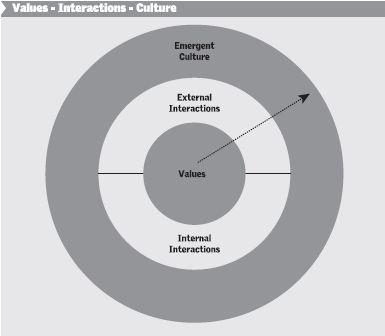
Values-Interactions-Culture
The resulting model would be as depicted in the accompanying figure. At the heart of the model are values — these are to be very carefully determined by the leadership of the organisation and periodically reassessed. These values form the basis of countless interactions between members themselves, and between members and other stakeholders such as customers.
The resultant emergent phenomenon would be the organisational culture. In order to foster a strong link between values and actual behaviour, reward systems must be aligned to incentivise demonstration of values.
Finally, it must be recognised that well ‘designed’ values help to actualise the ‘unique goodness’ of an organisation through the creation of an enabling culture, which in turn ensures that people who intend to contribute meaningfully are not hindered in any way from doing so.
------------
Older columns are as follows:
Wednesday, October 1, 2008
The new Microsoft campaign
Monday, September 29, 2008
Changing Time
My latest column for The Hindu Business Line is as follows:
As the Indian economy grows over the next decade or so and a predominantly young population enters the workforce, a big problem that is likely to emerge is a certain loss of meaning. The early symptoms are already visible in the form of high attrition and low employee morale and loyalty across all levels in most industries. It appears that human fulfilment would ironically face its biggest challenge from rapid economic growth and its numerous harmful side-effects. One such side-effect is the commoditisation of time.
Unsustainable bubblesIn a recent article, MIT professor Peter Senge proposes that the very notion of the Industrial Revolution is a bubble much like the dotcom bubble of a few years ago. The current climate change crisis we are facing is a fall out of this bubble, which is now in its last stages. Over a long period of time, rapid industrialisation has occurred in a manner that has been completely out of sync with nature and the costs of those actions are beginning to be borne now.
In much the same way, rapid economic growth leads to another bubble — an unhealthy relationship between people and the time they have on their hands. The people inside the bubble are led to believe that time can be spent on only two kinds of activities — either in the production of goods and services as part of the workforce or in the consumption of the very same goods and services. Needless to say, this view is completely out of sync with the way human beings are designed, as creative agents who seek fulfilment through multiple dimensions (depending on their orientation) including economic activities, community, family, art, service to society, spirituality and so on.
The leisure economyThe Leisure Economy is a book by Linda Nazareth that explores how “changing demographics, economics and generational attitudes will reshape our lives and our industries,” and how the ‘time bubble’ discussed in the previous section is headed towards its end. In the book, she proposes that as Gen X and Gen Y individuals dominate the workforce over the next few years, they will discard many old notions about work and leisure time. It is not hard to see that the cultures of companies founded by Gen X/Y entrepreneurs (like Google) is radically different from the cultures of older organisations with regard to how the workforce spends its time, as well as the manner in which a closer integration between work and other aspects of life is encouraged.
Timothy Ferriss, author of the best selling The Four Hour Work Week also makes a strong case for looking at work and leisure in a new way. Amongst other things, he advocates the idea of taking a number of ‘mini-retirements’ over the course of one’s working life as opposed to the traditional notion of retirement as one long stretch of time (of delayed gratification as it were).
Towards a more balanced worldWhile the leisure economy may be an emerging reality in highly developed economies of the West, it may well be some time before it comes true in developing nations. However, considering the globalised world we live in today, one could guess that the learning curve would be far more compressed. Either way, the trend clearly points to a future where people will look for fulfilment through multiple dimensions with the underlying currency being time and its balanced allocation across dimensions. Secondly, there would be a growing realisation that human fulfilment is an ongoing parallel activity across all these dimensions and suppressing one in the interest of the other will inevitably fail in the long run. Finally, the notion of time as a commodity would be replaced by the notion of time as a currency, as a form of income that is as important as financial income.
Previously published columns:
Sunday, August 17, 2008
Health care entrepreneurship
The invisible hand of the economy is beginning to touch health care in India:
Dr Shetty is turning serial entrepreneur. The grand plan is to set up health cities in several state capitals with training institutes for medical manpower. Health cities are large complexes that will house different specialties for treating major diseases, and both state governments and private equity have bought into Dr Shetty's vision for transforming the health landscape of the country.While AIG and JP Morgan have pumped in Rs 200 crore each for a combined 25 per cent stake in the holding company Narayana Hrudyalalya Private Limited, state governments have offered large tracts of prime property in Ahmedababd, Jaipur, Bangalore, Bhubaneswar and Dehra Dun.
This is by far the most ambitious expansion drive among private players in the country with Dr Shetty expecting to add 20,000 beds in the next five years.
Monday, July 14, 2008
Wealth in Ideas and Relationships
My latest column for The Hindu Business Line appears today. Providing both the link and the full text below.
Wealth lies in Ideas, Relationships
Mohit Kishore
Wealth lies in Ideas, Relationships
Mohit Kishore
“If you have an apple and I have an apple and we exchange these apples then you and I will still each have one apple. But if you have an idea and I have an idea and we exchange these ideas, then each of us will have two ideas.” - George Bernard Shaw
In its own way, this quote seems to suggest, and quite rightly, that wealth lies not in physical objects but in ideas.
It seems that the biggest mistake businesses make is in their search for wealth in the marketplace.
There seems to be a notion that the purpose of business is to map the wealth in the marketplace, in the pockets of ‘target groups’ and ‘customer segments’, and somehow transfer that wealth into the books of the business by providing goods and services.
To me this seems a transactional, non-sustainable approach. In my view, real wealth lies in two things: Ideas, and relationships.
Ideas
No business can be sustainable over a prolonged period of time by merely doing the same thing over and over. The outsourcing industry works on the idea that technology can be used to do non-core activities for companies in remote parts of the world, where labour costs are lower.
However, it is evident that this idea alone is not enough to sustain the outsourcing industry for ever.
In India for instance, the fast growth in the economy, high attrition and rising wages means that the cost of operations for the outsourcing industry is going to rise, and the idea of labour arbitrage may soon lose relevance.
This means that for this industry to be successful, newer and newer ideas are required that ensure that competitive advantage is maintained.
The same is true for any organisation. Not many ideas are of eternal value, and hence there is a constant need to evolve newer and newer ways of doing things.
Mature economies realise the value of ideas, and this explains why one finds a strong culture of venture capital investors investing in small, innovative, early-stage companies working on new ideas.
They realise that the risks in such investments are high, but the rewards can be substantial.
Relationships
The second source of wealth lies in relationships, particularly with customers, and on a larger scale with other stakeholders — society, nation and the environment. Iconic companies tend to focus on one or more dimensions of these really well.
For instance, businesses of the Tata group in India have always had a strong sense of nation-building and social responsibility associated with them. The wealth that lies in strong relationships manifests itself in the form of brand equity, which is, in itself, a source of material wealth (through increased sales, customer loyalty, etc.)
Apple is another company that values its relationships with its customers to such an extent that there is a reciprocal relationship from its customers that borders on devotion – something that causes them to buy high-priced initial releases of Apple products despite knowing that the prices will come down drastically in a few months.
Transactions not equal to wealth
It appears today that a lot of organisations value transactions over ideas and relationships.
An undue focus on transactions as a source of wealth means that market share and sales assume a central role in business.
When this happens, there is a large amount of ‘mis-selling’, poor customer loyalty, a lack of focus on customer service, low value on ethical behaviour and an overall deterioration of enterprise value. Some pockets of the financial services industry (like credit cards) are already demonstrating the effects of such a deleterious strategy.
Wealth = Ideas + Relationships
This is not to suggest that wealth in material terms is bad. It is only bad when this wealth becomes the central driver of strategy.
In fact, a study of successful organisations clearly shows us that wealth in material terms (revenue, market share, and so on) is an automatic by-product of the wealth contained in ideas and relationships, and a strong focus on these two dimensions is not just a one-time affair (at the time of the founding of a business) but a long-term, on-going process of adaptation and evolution.
Previously published columns:
Wednesday, July 9, 2008
Business Today b-school rankings
Business Today has once again come out with it's illogical survey of b-schools. I have already criticized it here last year. Wont add anything more!
Thursday, July 3, 2008
Interview of UTV's Ronnie Screwvala
UTV's Ronnie Screwvala makes some interesting observations about "Scale versus control" in this Knowledge@Wharton interview.
That was a crossroads that we had already crossed -- UTV as a company and myself personally. For me, scale is more important than control. Once you start thinking about scale, performance is going to count in any case because we are a public limited company. Whether Disney thinks I am a good CEO or the rest of the shareholders think I am a good CEO is equally bad or good -- because I have to be accountable for my performance. The other thing that comes about when you cross the 51% threshold in shareholding is that of overall accountability in that context -- and therefore management versus shareholding. If I think I am not the right person to lead the company at the next level of its growth, I could just continue to be a shareholder.
More here
Subscribe to:
Posts (Atom)