Monday, September 25, 2006

The networked marketplace [featured in The Hindu Business Line]

Today's Hindu Business Line carries the following article written by me. Link to the article on the Business Line website: The networked marketplace

Full text of the article follows:

"A powerful global conversation has begun. Through the Internet, people are discovering and inventing new ways to share relevant knowledge with blinding speed. As a direct result, markets are getting smarter — and getting smarter faster than most companies." — The Cluetrain Manifesto

The implications are clear. Modern organisations need to be more nimble, more clued into what is happening in the external world — in the real world. They need to `talk' to their customers, not `talk down' to their customers through flashy corporate ads. They need to project a voice that is authentic and not sugar coated in marketing spiel. Companies need to start appearing genuine, human, humane and vulnerable if need be. This is the message of The Cluetrain Manifesto, a pathbreaking book, which in the true spirit of the Internet is available freely on the Web.

Very few companies, if any, have woken up to the reality of the networked world. So, one sees companies that do the market research, decide the product and brand attributes, launch the product and wonder what went wrong. What is likely to have gone wrong is that your customers have been talking to each other and spreading the `word' faster than your `advertisements'. Be it film reviews, music reviews, product and gadget reviews, people are talking, and talking like never before. Products get trashed before the first ad comes out.

Here is an insight that organisations need to pay attention to: Customers trust human voices. This explains why nothing beats word-of-mouth publicity, and today the biggest word of mouth movement is happening on the Internet.

Building Relationships

After all, every purchase made by a customer is a new relationship created with the company whose product the customer has bought. When I receive my monthly phone bill, I notice that it bears a `relationship code'. Yet companies do little to nurture a customer relationship the way a human relationship is nurtured. Strong brands like Google actively engage their customer in the `conversation'. The Google Blog for instance, is a place where customers can see what the guys at Google are up to . It's about time brick-and-mortar companies too embrace this new form of conversation. And as the manifesto says, "Because they are networked, smart markets are able to renegotiate relationships with blinding speed."

Employees of organisations are also part of this new form of conversation. People are actively and virtually networking with each other to find out more about each other's organisations. Employer brands are being created and destroyed in this brand new market place as fast as thought and the strokes of a keyboard. Secondly, markets too want to talk to employees. They want the inside track on what really goes into their products. Companies need to let go and let this conversation happen freely. Robert Scoble (Microsoft' erstwhile star blogger) did more to humanise Microsoft than any ad campaign ever would have.

The way forward

As I see it, the way forward would be for companies to view `advertising' as one of the ways of talking to customers, and not the only way. All kinds of organisations need to embrace the power of the Internet as the new global market place where brands will be created and destroyed — where your multi-crore ad spend will be thrown into the bin when your customers rant about your call centre service on their blogs. The future is a world where mere brand logos and taglines wont suffice. It will be a place where brand voice (how your brand talks to your customers) will assume more significance. Brands would need to be `humble' and not mighty; brands will have to understand, rather than be understood; brands will have to listen and not talk.

It's a brand new era that is unfolding (and, indeed has been unfolding over the last few years). Blogs, social networking, Web 2.0 and so on are all going to fundamentally realign the way society is structured, and people will be netizens of the marketplace first and then citizens. The future looks exciting, and archaic institutions will need to embrace this change for their own good.

Tuesday, September 19, 2006

Machiavelli on Leadership

"Moreover, men are less careful how they offend him who makes himself loved than him who makes himself feared. For love is held by the tie of obligation, which, because men are a sorry breed, is broken on every whisper of private interest; but fear is bound by the apprehension of punishment which never relaxes."

From Niccolo Machiavelli's The Prince

Seems to be a reference to Coercive power, which is one of the 4 sources of individual power.
---
Legitimate power: From holding a formal position. Others comply because they accept the legitimacy of the position of the power holder.
Reward power: Target complies in order to obtain rewards controlled by the agent.
Coercive Power: Compliance is to avoid punishments controlled by the agent.
Expert Power: Based on a person’s expertise, competence, and information in a certain area.
Referent Power: The target person comply because they respect and like the power holder (agent).

Saturday, August 26, 2006

Lessons in Positioning - Nokia n-Series Vs Reliance Infocomm

My favourite ad on television these days is the Nokia n-series ad. I cannot think of any other ad that communicates to it's target segment as precisely (like a hot knife through butter, if I may use a Sidhuism) as this one. The film opens to the shot of a guy removing rings pierced on his face, and moves on to a guy with long hair, who gets a haircut (and I presume a new Nokia n-series phone), then we move on to a guy who trades in his old tattered jeans for a new one, and similar such life situations where people make that transition from being young and rebellious, to older more mature selves. The fantastic jingle begins with 'Zindagi ki nayi mod pe, aa gaye aaj hum' - which roughly translates to -Today, we have come to a new turn in our lives. The positioning is crystal clear - the n-Series is not your first phone, it's your second phone, the one you buy when you move up in life, the one you buy when you have had enough of living your rebellious college bum life, and move on to greater things (like employment, your first car etc).The whole ad just focusses on positioning and customer segmentation (by stage of life) - no rubbish about the phone's features or the prices. Sweet.


Check out the clip below

On the other hand, we have the new and youthful 'Reliance Infocomm', which has absolutely gone berserk with colours. Their new ad celebrates 2.5 million customers (and growing). However, the positioning goes haywire. The ad features these young twenty-somethings humming the new Reliance signature tune, while facts about the company appear to their right (in colours that I can only call vulgar). The average Reliance customer is NOT trying to make a statement about his cool quotient through his brand choice. It is more likely that he is a cost conscious person who wants a basic connection.
What seems to have happened is that Anil Ambani has decided that all his brands will be 'youthful', in stark contrast to brother Mukesh's staid brands. So, suddenly Reliance Infocomm (which had, and continues to have no brand attributes associated with it except cheap) finds itself in a desperate situation trying to be young and hep, instead of being itself - a lesson that is as important for a brand as it is for us mortals.

Sunday, August 20, 2006

The analytical genius of Times of India

This article (titled, Want salary hike, join financial sector) on increase in salaries in the financial sector points out:

"India Bulls was amongst the highest payers in financial sector with a 262.44 per cent increase in their staff cost. Firms like Geojit Financials, IL&FS and CRISIL also registered 82 to 85 per cent rise in their staff expenditures."

Thus TOI would have us believe that a 262% increase in staff costs, corresponds to a 262% increase in salary, thereby making Indiabulls the highest payer in the financial sector. Wow. Now, if Indiabulls doesn't hire you, I suggest you head to Balaji Telefilms , where again the staff costs went up by 251%. Needless to say, TOI would like us to believe that this means that salaries went up by 251%.

Do we need to point out that staff costs go up when you hire more people (both Indiabulls and Balaji being growing companies), and not necessarily because you are paying your people more.

"The salaries rose by over 251 per cent in Balaji Telefilms and the drop in the profits of firms like Cinevistaas, UTV, Zee Telefilms, Mid Day Multimedia and TV Today can be partly attributed to the increasing staff costs, the release added."

I can see the young journalist writing this piece as it was originally meant to be - one about salary costs going up and affecting bottom lines. But, why would an ordinary reader of TOI be interested in something like that? He would be interested if you told him that salaries (particularly his own) are going up. Now, with that marketing insight in place, all you need is to substitute the phrase 'staff cost' with 'salary' in a few places in the article, and you have a story about salaries - which can then be given a juicy title - Want salary hike, join financial sector. Subsequently, this story can be put up right in the front page of the website, where readers will keep clicking, generating more revenues for TOI (Cost per ad impression).

Friday, August 18, 2006

MBAs prepare people to manage nothing

Or so says Henry Mintzberg .

To some extent it is true, because most MBA courses focus only on functional areas, and not on true people management or leadership. An ideal MBA course should probably focus on business concepts in the first year, and pure practical management and leadership in the second (possibly through social projects, live consulting projects, startup incubation etc.), culminating with placements.

I suppose one of the main reasons why IIMs, XLRI etc produce successful business leaders could be that the input raw material itself represents the topmost performers on the entrance tests with 10s of thousands of candidates, a group of people who I suspect would succeed anyway.

Wednesday, August 2, 2006

Carnival of the capitalists

The lastest Carnival of the capitalists, featuring great posts from the week from business and economics blogs is out. Incidentally, this week's edition happens to feature Slow Leadership, a blog I recently wrote about.

Downtoearth.org.in - a new kind of cola war

If it wasn't enough that softdrink makers use up precious reserves of ground water (thereby depriving farmers of the same) and spend very little on it, they now wish to have no standards to be set for pesticides in soft drinks. They contend that since vegetables, milk etc already contain pesticide, what harm can a little more of it do?

Three years after releasing the findings on pesticide content in softdrinks, the CSE continues its fight.

Read this, from downtoearth.co.in : The street fight
And read this from The Frontline: Thirst for Profit

---

Update: Since this post is attracting more comments, thought I should add some more views on the way the issue is being handled by the cola companies. They seem to have realized that the best way to react to any controversy in India (be it terrorism, flooding in Mumbai etc) is to just keep quiet, and hope that the issue dies a natural death in our collective consciousness.

Secondly, this is also an example of how companies view customers as 'target segments', (who can be fooled into buying a product, leading to increased revenues) instead of actual people. What I would like to see instead is an 'explanation', not a yogic meditative silence on the issue. If you believe that the pesticide content in your product is at acceptable levels, tell us why you think the CSE is wrong, and don't put your US lobbies into overtime duty by threatening that this issue could affect FDI prospects in India.

Thirdly, the argument that there should be standards for inputs in the product (water, sugar etc), but not the final product is illogical. Consumers drink the final product, and not the inputs whatever their level of purity may be. I have noticed pani puri sellers who put up little signboards that say 'Only Aquafina water used for pani puris here'. Surely, we expect better from a multi-billion dollar MNC.

And finally, I am sure other industries too use up ground water. But lets have answers from the soft drink makers first, shall we? I suppose steel and paper contribute in some manner to nation building, whereas softdrinks just corrode teeth, and make people fat. Mangola (Pepsi's mango drink) for instance, contains about 15 grams of sugar per 500 ml, and if I am not mistaken, the dietary requirement of sugar would be about 12 grams for an entire day. (I could be wrong about this last bit though.)

And yes, in case you did not read the Frontline article at the top of this post, do so now. Click here.

Monday, July 31, 2006

Leadership vs Management

I have always believed that leaders and managers are two different kinds of people. This article, distinguishes between leaders and managers quite well.
Leaders conceive and initiate strategies that create and sustaincompetitive differentiation and advantage. They continuously pursue and evaluate innovations that may lead to increased productivity, new business opportunities and markets, and new or expanded competitive advantage and differentiation. They direct and influence corporate activities and behaviors to develop an environment and processes that support and sustain these strategies

Managers implement strategies in day-to-day operations. They establish processes and systems, create business rules and operating procedures, and monitor performance to maximize the efficient production of the company's products and services. They have the frontline responsibility for ensuring efficient and appropriate use of company resources, including equipment, employees and capital.
Thus, in summary it appears that leaders think, and managers implement. Now, here is my insight:

Most orgnanizations actually reward good managers. Good managers, over a period of time tend to occupy leadership roles. Is this necessarily good? The skill sets that are required from a manager seem to differ from what a leader requires. A manager is likely to be one who is good at delivering results, planning, organizing, people skills, data analysis etc. A leader on the other hand would need to begood at analyzing the environment, predicting trends, understanding human potential (of his team), influencing people and so forth. Plato believed that philosophers would probably make good kings. In the same vein, it appears that a good leader would be one who is an evolved creature, who can get away from the mundane operational issues, and look far ahead into the future.

Now, if this hypothesis is true, shouldn't organizations look for different kinds of people to occupy these two kinds of roles. In other words, I would like to see organizations look at creating two kinds of talent pipelines - a management pipeline, and a leadership pipeline, and not mix up the two. The management pipeline would consist of the left-brainers, the people who know what needs to be done to get the job done - the analytical people, who are good at making plans, roadmaps etc. The leadership pipeline would consist of the people with softer skills - creativity, intuition, vision, good values, a sense of justice, fairness etc. A leader is almost like a lighthouse, that creates paths, while good managers are probably like sailors who know where to go thanks to the lighthouse, but need to use their own talents to 'get there'.

Needless to say, this classification may make the 'leaders' appear more glamourous, but that is the case anyway in most modern organizational hierarchies. I however believe, that both skills are equally valuable - without good management, ideas would just remain ideas.

Saturday, July 29, 2006

The new and improved 'Management by Matrices'

As you can see, this blog has just made the leap of faith, from being a drab old blog (in terms of look, not content!), to a sleek, sexy branded look. Many thanks to Joshua 'design' Karthik for that.

I recently discovered, that a few quality blogs (like this one), find this blog's content worthwhile to list it in their favourites. That was motivation enough for me to go for a more branded look, in addition to trying and maintaining a healthy posting frequency. Now, if only I actively 'promoted' this blog, I suppose more traffic would come in. However, I tend to be a little more traditional in my views as far as promotion is concerned. I would prefer my readers to do the promotion if they like my stuff, rather than do it myself. Yes, I seem to be disregarding, an important 'P' of marketing. Hmm..who knows, I may just decide to turn immodest!!

Watch this space for more...

Saturday, July 22, 2006

Slow Leadership

I thought I was the only one who did not support the modern management style of 12 hour working days, and break neck speed decision making. Turns out there is a dedicated blog on this, that advocates a form of leadership that they term 'Slow Leadership'. This is a link to their first archive page.

The eight key principles of Slow Leadership:

1. Right Tempo
2. Right Attention
3. Right Balance
4. Right Perspective
5. Right Direction
6. Right Relationships
7. Right Enjoyment
8. Right Gratitude

Reminds me of Stephen Covey's approach, that tends to focus more on the basic human side to leadership, and not the superficial jargon laden one. The move to the 'basics' has been an ongoing management trend that I have observed. Business schools too have realized that Organizational Behavior is probably a more important leadership tool than say, Financial Management. We seem to live in a world that admires speed more than anything else. There is an acute sense of there not being enough time to do anything, which stems from an equally acute desire to do everything at once.

In such a fast paced environment, we need to re-look at the people side to enterprise. We need to understand that organizations exist to serve not just customers, but also employees. Slow Leadership seems to advocate this deliberate slowing down. Human beings need to reflect, as much as they love to act. Modern organizations tend to focus more on action, and allow little time for reflection. In this quest for bigger, better and faster, are we becoming better people, or are we becoming 'resources', a term often used by HR managers to refer to people ?

Monday, July 3, 2006

Smaller cell phones please...

I've been looking at the trend of mobile phones growing in size with amusement. I thought the logical way to go would be have smaller and smaller phones, till you had one that fit into your ear (or implanted into your brain!). On the contrary, mobile phone makers are trying hard to fit in every possible function into the device from camera's to FM radios to e-mail clients. As a result, the end product is a lot more bulky than a purely functional phone. A better way to do things would be to make smaller phones that do the basics, which have lighter batteries that last longer, which radiate less heat, which probably integrate voice with video and which finally make the 'talking to people' experience better.
It's about time somebody did to mobile phones what Apple did with the i-Pod - create a super simplified phone that can be used for only one thing - making calls. I mean, who uses a mobile phone for any serious photography??

Thursday, June 15, 2006

Google versus Microsoft, and the Henry Ford trap

Google and Microsoft differ fundamentally in their views on Office applications. While Google is all for having the application residing on a server, with the user accessing and using it through a thin client (browser), Microsoft believes in the traditional notion of having the application reside on your hard disk. [read about Google Spreadsheet]

In the medium term, with bandwidth being an issue, apart from the fact that there is only so much you can do inside a browser, I expect Microsoft to win the Office battle. In the long run too, with cheap hard disk space and cheap processors, I do not see much benefit in a browser based Office suite. One benefit that I forsee is that collaborative editing (example, Writely) may really take off (people in remote locations editing the same document over the Internet), but I am sure the guys at Microsoft will find a way to include collaborative editing within Office.

Is Google falling into the Ford trap ('People can have the Model T in any color - so long as it's black.') with it's insistence on developing applications that reside in the browser? Time will tell, but my hunch is yes.

Wednesday, June 14, 2006

Reward loyalty or performance?

All organizations reward members for loyalty. I am wondering whether this is the right strategy, particularly when loyalty is not accompanied by performance. Is retention such a high priority that organizations would like to keep people (even bad ones) at any expense? The answer may lie to a small extent in the realm of emotions. An employee who has stuck around for long with a company is likely to have a strong sense of affiliation to it, and is likely to serve the organization favourably in his decision making and performance (even if it isn't peak performance). It probably pays to have such people with you, rather than those who crib at every opportunity, and may jump ship any day. Secondly, and more importantly, rewarding loyal employees may also help to serve as a signal to good performers that hints at what their own future might be like. The question here is whether the signal may actually fail, if good performers begin to think that loyalty assumes precedence over performance.

My personal view on this is that only performance must be rewarded. Rewarding loyalty, purely as a symbolic measure is just going to be that - symbolic - and not greatly beneficial. Moreoever, rewarding performance is likely to increase loyalty of good performers, thereby leading to a virtuous cycle. Productivity in goverment offices gives us a hint of what happens in organizations that only look at loyalty at the expense of performance.
----
Nirav, points out an interesting example of a reward system that combines loyalty and performance - stock options! You get them only if you stick around, and you reap the benefits only if your company does well (which indirectly means that you have to contribute to the cause).

Monday, June 12, 2006

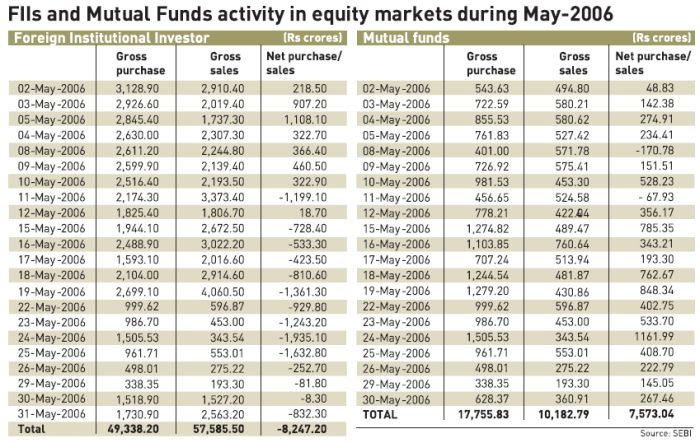
The Stock market - Could Mutual Funds support the market in some distant time in the future?

I'm no stock market expert, but look what Mutual Funds were upto during the recent (and indeed ongoing) Sensex 'correction', and all the bloodshed that followed. This could be an indication that in the long run, MF's and retail investors could actually support the market.

I am also convinced that behavioural economists probably do better at the stock market than those who follow scientific methods such as 'top down' or 'bottom up' stock picking. But then, I am no expert!

Source: Frontline's cover story

Sunday, June 11, 2006

Servant Leadership - another fad

The concept of Servant-Leadership was coined by Robert K. Greenleaf (1904-1990) in his essay The Servant as Leader.

Servant leadership is a form of leadership in which the leader desires to 'serve' first, and then assumes a leadership role by conscious choice. Greenleaf recommends that the simple mantra is to just 'serve' others in whatever situation you are faced with. Followers, while being served, become 'healthier, wiser, freer, more autonomous, more likely themselves to become servants themselves'.

The concept seems to boil down to "selfless service", not unlike what Indian philosophical texts have been recommending for thousands of years now! To me the whole concept of 'Servant leadership' seems more like a management fad than anything else. It seems to be a fresh articulation of leadership tenets that have existed for long. In fact most business books fall under this cateogory, possibly because modern managers don't read enough, and need to be spoon fed with easy to remember concepts in the form of 'The One Minute Manager', 'Principle Centred Leadership' and other such 'for dummies' books.

Signaling theory

An interesting post from a Fazeer's blog on economics, which I have been frequenting of late.

Monday, May 29, 2006

Published in The Hindu Business Line

Today, The Hindu Business Line (a leading mainstream business daily in India) carries an article written by me on decision making in groups. The article appears in page 10 of the main sheet.

Link to the article:
Why groups make bad decisions

You can send me feedback at mohit[dot]kishore[at]gmail[dot]com.

Saturday, May 27, 2006

Purpose before profit

I have earlier written on mission and vision statements here.
Now, read a similar post from Talentism that talks more about the importance of a clear 'purpose' for every business. Purpose before Profit.

Wednesday, May 24, 2006

Project Manager Leaves Suicide Powerpoint Presentation

Over time, managers tend to think in the form of Powerpoint presentations, bargain with shopkeepers keeping concepts like opportunity costs in mind, and use 2x2 matrices in their personal lives.
That eternally funny 'news' source - The Onion has this hilarious "story": Link
Project manager Ron Butler left behind a 48-slide PowerPoint presentation explaining his tragic decision to commit suicide, coworkers reported Tuesday. "When I first heard that Ron had swallowed an entire bottle of sleeping pills, I was shocked," said Hector Benitez, Butler's friend and coworker at Williams+Kennedy Marketing Consultants. "But after the team went through Ron's final PowerPoint presentation, I had a solid working knowledge of the pain he was feeling, his attempts to cope, and the reasons for his ultimate decision." "I just wish he would've shot me an e-mail asking for help," Benitez added.

Saturday, May 20, 2006

The importance of Mission/ Vision Statements

I don't know why companies do not give enough importance to their vision and mission statements. As organizations grow larger and larger, it is only the top management that has any clue about why the business exists in the first place. Employees lower down the hierarchy are unable to see the grand pattern in their mundane day to day activities. When employees find that the organization's goals are not in sync with their own personal goals (or when they have no clue about what the organizations's goals are) they start looking out for other jobs. People like to, and should, be part of causes which are larger than themselves. The employees at Google, are likely to strongly believe that what they do on a day to day basis will revolutionalize the way people view computing and technology. Check this link, to gain an insight into Google's corporate philosophy.

Vision statements and mission statements convey in a few words, what it is that the organization exists in the world for. Their brevity enables stakeholders to easily remember, imbibe and apply the tenets of the founding fathers of the organization. It also tells you in a few words whether or not an organization is for you or not. If a company's mission statement was - "To be the most ruthless widget manufacturer with the supreme goal of wiping out competition" - would you join it? Of course, I have to admit that most vision/ mission statements are really sugar coated and sound glorious. That is only because the people who are crafting them do not think the exercise will add any value to their organizations. They think it's more of a PR exercise for the benefit of the outside world.

If companies pay closer attention to the vision/mission statement, and tie organizational objectives to it, evaluate every step they take in terms of whether or not it will help them achive their mission, employees would be much happier. At least, they would have a clue about what the hell is going on, instead of just selling more of whatever it is that they sell.

Incidentally, the Balance Scorecard is one such approach where strategy flows from the organization's vision and is translated into four perspectives - financial, internal, customer and organizational development. It is inherently a good concept, and it probably works because most organizations rarely have a right brained vision/mission. They usually have a very quantified, market related definition of why they exist. With a left brained mission like "being number one in the market", a Balance Scorecard becomes like a simple execution roadmap for the same. It lacks that one key magic element - "passion".

Needless to say, just having a great mission/vision statment is only the first step. The next step is of course execution! This is done through rewarding employees who actively demonstrate the values of the company in their day to day dealings with other people.

Of course the job doesn't just end with Vision / Mission Statements. These statements must also flow in the values, which in turn flows into actual behaviours and organizational culture.

Read this new post for more on this topic.

Also check this post on Netflix's culture and values.

The role of strategy in firms

My latest column for The Hindu Business Line explores the role of strategy in firms . Full text follows -- While there are many defini...