Thursday, March 15, 2007

Interactive Brands - featured in The Hindu Business Line

Today, The Hindu Business Line's Brand Line supplement carried this article written by me. Link to website: Interactive Brands

Full text follows:

Today's young adult spends significant amounts of her time using the Internet. The Internet has become the dominant medium of keeping in touch, networking, sharing views with people all over the world, researching and getting work done (if you are a knowledge worker). The membership figures of prominent social networking sites such as Orkut and Facebook is indicative of this undeniable trend.

The young adult of today's world is hyper-networked, interlinked to many more people than before, and part of many more conversations than ever before. Marketers who are today selling their brands to a spectrum of target groups of which such hyper-networked individuals constitute a small but significant chunk will realise (as these individuals age) over the next 10 years that the entire marketplace has turned hyper-networked.

Are brick-and-mortar companies prepared for this change? I doubt it. The difficulty of `selling' to such hyper-networked individuals is that they are highly sceptical of advertising, branding gimmicks and PR spiel. This group tends to form and create opinions through n-way conversations that take place on the Internet through blogs, social networking sites and e-mail. Such communication is not just text-based - it could even take place through videos (YouTube), images (Flickr) and voice (podcasts).

The important feature of these conversations is that the information they contain is viewed with much more trust, primarily because such conversations do not have a hidden profit motive. The equivalent to this global conversation is the `word of mouth' benefits that brands earlier enjoyed in the brick-and-mortar era.

Join the conversation

The solution that one foresees in such a scenario is for brands to turn interactive, and actually join the conversation. Interactive brands would be those that effectively conduct two-way conversations with their defined marketplace. The earlier era was one of uni-directional communication, which involved running advertisements and other branding initiatives on one-way communication media such as the television, radio and billboards. Potential customers were expected to passively absorb messages from such media, and consume the advertised product or service. Occasionally positive word-of-mouth contributed to brand choice in addition to the creative message. However, with the emergence of the Internet, word of mouth assumes a much more significant and globe-spanning role in brand choice.

Corporate blogs

How then do brands engage in two-way interactions with their defined marketplace? One effective way to do this is a corporate blog, which incidentally finds itself in Bain Company's list of top 25 management tools of 2007. A key benefit of a corporate blog is that it enables an organisation to communicate in an honest, human voice to the world at large.

This honest voice would involve such former taboos as publicly acknowledging mistakes as and when they occur, honest promises on customer service levels, transparent communication on future product launches and internal thought processes. In addition to this, customers can use this forum to openly talk to the company, and about their experiences with the company's offering. A static corporate Web site can never create the kind of interactivity and richness that a corporate blog can offer.

Community of users

Another way for brands to get involved in the conversation is to create communities of users. Two examples come to mind - The Royal Enfield owners club of the UK, and closer to home, Sunsilk's `Gang of Girls' Web site. Such communities allow customers to interact with other users of a product or service, and have conversations that have the incidental benefit of providing inputs to product development initiatives. Additionally, they would also help companies observe the evolution of their customers, and respond much faster than ever before.

It appears that brands will have no choice but to be part of the conversation between users, or risk being left out completely. This is not to say that traditional brand building approaches are no longer valid. They still have a role to play, but that role is more likely to help in reinforcing the brand's message, rather than creating it from scratch. Additionally, smart brands will no longer view people as `target groups' but start viewing them as people whom they can best understand through conversations.

Iconic brands tend to tap into a customer's self-actualisation needs on Maslow's hierarchy of needs. People get emotionally involved with brands when they can relate to the brand in a manner that goes beyond mere price or quality. It is equally important for brands to get emotionally involved with their users by joining the conversation, or risk commoditisation. The choice is clear!

(The writer, an alumnus of XLRI, is with a multinational financial services firm.)


Some of my previously published articles.

Sunday, March 4, 2007

Cricket ads

With the World Cup around the corner, it's time for some very interesting cricket centric ads. Marketers will try every trick in the book to associate their brands with India's inexplicable obsession with cricket, and hope for a reciprocal Pavlovian passion for the product to develop. This one is the new Nike ad. Excellent stuff. Notice how Sreesanth and Zaheer Khan have the most insignificant role in the whole story. I have a feeling the ad is trying to tell us that the Indian cricket fan is much bigger than the Indian cricket star. I love the way the ad has this "order in the midst of chaos" feel to it, that only Mumbai can create.


And here's an old Adidas ad featuring Sachin, that still gives me goosebumps. Notice how the phone rings throughout the ad, as the world comes to a standstill waiting for Sachin to face the delivery. This is probably the best Sachin ad of all time, because it just lets him do what he is good at (playing cricket) without having to mouth any inane lines like 'Visa power, go get it'.


Tuesday, February 27, 2007

Self promotion

Many of us are uncomfortable about self promotion, even if it is with regard to something that other people would really want to know about.David Maister talks about this phenomenon in this very interesting post and podcast.

Technorati Tags: ,

Monday, February 26, 2007

Corporate blogging - my thoughts

Over at Abhilasha's blog I found some interesting questions raised by her on corporate blogging. In this post I attempt to answer a few of them:

1. Why should my organization blog?
For starters, if you are a consumer facing company (B2C), it helps to have an open conversation with your customer. Customers love to know what their favourite companies are upto. This is more so in the case of products that early adopters love (tech products, gadgets etc). A corporate blog can also become a very human touch point for customers, when compared to a boring website or even worse, a call center!

2. What realistic expectations can my organization have about the benefits of blogging, and what
obvious pitfalls or shortcomings should we be wary of?
A great, engaging blog does a lot more PR than a press release ever will. A great corporate blog can also help develop a loyal community of users around a product. Human beings love to be connnected to causes - sometimes, merely promoting a great product (like the I-pod) can be a cause. A blog can help create such a cause.

3. Who in the organization should blog?
I would say, the most important decision makers should. That way promises made on the blog will carry much more credibility.

4. What role does PR/ Corporate Communications have in this?
None! Blogs are the new age response to that tiring, sugar coated thing called the press relase.

5. What guidelines/policy should govern corporates bloggers?
Preferably none. However office bitching could be avoided!! A broad guideline coule be - say anything you want, as long as it is something that the customer is interested in knowing.

6. How can my organization measure the impact effectiveness of corporate blogging?
There is no need to really measure effectiveness. Think of it this way - what is the impact of a CEO talking one to one with millions of customers everyday? Its difficult to put a number to that. That's because the revenue you earn from a corporate blog is goodwill.

Technorati Tags: , ,

Tuesday, February 13, 2007

Kawasaki on market adoption

The top ten stupid ways to hinder market adoption

Guy includes one of my pet peeves - enforced immediate registration - as one of the barriers. Couldn't agree with him more. I don't understand what the additional value 'registration' brings in in an Internet scenario, where identities can easily be faked. I'd rather have a million anonymous users than 100 users about whom I know everything, and whom I can later target for promotional offers.

Wednesday, February 7, 2007

Corporate blogs

What kind of companies should start blogs to communicate with their customers? My thoughts:

1. Smallish startups that don't have marketing budgets
2. Companies that have very few product lines, or even better just one product. That way the conversation can be 1 to N. N to N conversations are just noise!
3. Companies whose brands directly touch individual customers. I wouldn't recommend a steel maker to start a blog for instance. I would certainly like to see, say, a winemaker with a blog (like this one). People would like to talk to or listen to brands that they directly relate to.
4. Large organizations that have people who are mini-celebrities in their own right - Steve Jobs, Robert Scoble etc.

At the end of the day, a blog is just a medium. The message is always more important than the medium. So, unless you have something compelling to say to your customer don't start a blog!

Sunday, February 4, 2007

Mohammad Yunus at FICCI Mumbai

Recently, I attended a FICCI organized talk by Mohammad Yunus, the nobel prize winning proponent of microcredit. Thought I'd blog about it, but found an excellent existing post that covers it pretty well.

A talk by Mohammad Yunus

Saturday, February 3, 2007

Networked marketplace

An instance of how brands will suffer if they ignore the emerging networked marketplace.
Looks like Air Deccan will need to do some serious brand rebuilding.

Missed flight, delayed flights and Air Deccan

I think an interesting thing for Air Deccan to try would be to setup a corporate blog, and start an honest conversation with its customers, acknowledge where they are going wrong, and tell us what they are doing to fix things.


Thursday, February 1, 2007

Retail, and the invisible hand of the economy

Reliance, Bharti may storm microfinance.

A perfect example of how the invisible hand of the economy works. Each agent works in his own self interest, leading to a greater good for mankind. The retail revolution in India may unknowingly help in fighting poverty in rural India.

Self-aggrandization post

Gautam, India's number one business blogger considers this blog to be amongst his list of top Indian business blogs. Yay!

Saturday, January 27, 2007

Anecdote

I have always believed in the importance of narrative, and stories in organizations. Sometimes, these narratives assume even more importance than logical/efficient decision making. A typical example is the commonly heard "this is how we do things here". I found an interesting blog that is dedicated to such stuff - Anecdote. Anecdote is a consulting firm that works in this niche area.

Here's an interesting post from Anecdote - the difference between a sound argument and a good story

Bruner called the two modes of thought ‘logico-scientific’ (or paradigmatic) and ‘narrative’, arguing that:

the types of causality implied in the two modes are palpably different. The term then functions differently in the logical proposition ‘if x, then y’ and in the narrative recit ‘The king died, and then the queen died.’ One leads to a search for universal truth conditions, the other for likely particular connections between two events – mortal grief, suicide, foul play. (pp. 11–12)

To compare the two modes, Bruner claimed, is to understand the difference between a sound argument and a good story.

Thursday, January 25, 2007

What should I do with my life?

I will be posting links to interesting articles that try to answer this question that has troubled mankind for long. Will update this post over the next few days.

Steve Jobs - You've got to find what you love

Po Bronson's book - What should I do with my life?
Most attempt to answer it with one eye open, one eye closed. We let our fears govern our decisions; rather than challenging the validity of those fears, we accept the boundaries set by those fears, and end up confining our search to a narrow range of possibilities, like the guy looking for his car keys under the streetlight because he’s afraid of the dark. Some broad examples: we confine ourselves to a range that is acceptable to our parents or our spouse; we confine ourselves to places inhabited only by people "like us," meaning of our class and education level; we place too much emphasis on being respected by an imaginary audience; we shy away from avocations that take a long time to mature and pay off

Synchronicity!

On Jan 21st, I wrote this on an alumni group of XLRI

"I doubt if the i-Phone will succeed - the main reason being that for once Apple is entering into a field that already has a lot of path breaking innovation happening (in a few years phones went from being just phones to cameras to music players to e-mail clients etc).

The I-pod, on the other hand, was launched in an environment where there was hardly any innovation happening on the portable music player front. The Macintosh, and its GUI was also launched in a similar technological environment. Both these products turned into icons because of the disruptive innovation they brought in. Iconic products tend to tap into the customer's need to identify with something that is path breakingly unique unique, and not possessed by many (atleast to start off with).

My guess is that the i-Phone does not have enough disruptive innovation built into it."

On Jan 24th, Peter Fader, in an interview featured at Knowledge@Wharton said:

Fader: Apple is facing a very different market. It's a market that's far more mature than the MP3 Player market was at the time. It's a far more sophisticated customer base. Apple had the opportunity to go into the MP3 market and basically reshape that market and create the standard for customers' tastes and preferences.

Those things have already been done by the myriad players in the cell phone market. Apple can do a very limited amount of reshaping. I think that when this phone actually hits the market, some of the grand visions that Steve Jobs has as well as some of the Apple zealots are going to be rather disappointed.

Interesting to note the high degree of similarity. Talk about synchronicity!

Tuesday, January 16, 2007

Sanjeev Bikhchandani on Naukri's IPO

An excellent interview by Gautam.

Companies look beyond IIMs for fresh talent

Very interesting trend

Beyond a point, the rising salaries of entry level management talent from premier b-schools may actually become unsustainable, making them unaffordable for a lot of companies! Already, FMCG companies are facing the heat at premier campuses, with the financial services sector/ consulting firms offering much better pay packets. Wont be surprised if this trend becomes a full blown reality in the next few years, particularly with the small number of "premier b-school MBAs" churned out every year.


Saturday, January 6, 2007

The spiritual organization

A recent article of mine which appeared inThe Hindu Business Line.

Link to the article: The spiritual organization

Full text follows:

People who work in a `nine-to-five' kind of workplace must often wonder why `work' is structured the way it is. The modern nature of work has its underpinnings in the Industrial Revolution and its many factories. These factories presented an interesting challenge in how a large number of workers were to be efficiently managed to produce a desired level of output. Frederick Taylor successfully studied and analysed work in factories, with his simple motto being reduction in variability — in other words, viewing people as mere parts of a machine that had to work together to produce a desired product. Needless to say, this view of work and human resources could not last for long.

People do not necessarily work to satisfy an economic function. People work for various other reasons including fulfilment of their potential, following their passions and so on. Such motivations are much truer of the modern knowledge worker who works more in the realm of ideas and analysis as opposed to actions and objects. Yet, I find that most organisations still largely view job roles along the lines of the `parts of a machine' model described earlier. With most modern professionals spending a significant chunk of their waking hours at work, work ends up being an important sphere to achieve a lot of life goals apart from economic goals. Work may even become a path to spiritual development (suddenly shifting the focus from the here and now to the next world if there is one!). The Industrial Revolution (and the Protestant Reformation) on the other hand, made society focus more on this world, with work being an important component in it. The Industrial Revolution and the modern knowledge economy are at opposite ends of the spectrum in the nature of work they create. And yet, very little has changed in the approach that modern organisations have towards people.

Most organisations that claim to be modern in all respects — be it technology, strategy, CRM, operations and so on — manage to be extremely archaic in their people practices. I find a huge hangover from the industrial era still permeating the hallowed corporate hallways. It appears that the `modern' knowledge worker lives in a world populated by access cards, nine to five regimes, appraisals that tend to measure performance in the way a car's performance would be measured and so on. It is thus no surprise that the very term human resources seems to convey a view of people as input-output machines (pay salary, will work).

In my view, the organisation of the future must be a spiritual one. Its goals must be closely aligned with the life goals of its stakeholders. In such an organisation, I would give people the freedom to choose what they want to do, within broad constraints. The underlying theme would be that people inherently love to work when the kind of work they do is closely linked to who they truly are. This concept finds support in the Bhagawad Gita too, where Lord Krishna commands Arjuna not to be a coward, and to be true to his dharma (the true nature of one's personality). The current approach to hiring, on the other hand, seems to be one of `filling open positions'.

Second, the spiritual organisation would pay closer attention to the non-work goals of employees. This may mean allowing employees to spend significant chunks of time pursuing these goals even during the `working day'. Career growth paths would be super-customised and not standardised. Thus, on a broad level, a spiritual organisation would place self-actualisation before profits, and this paradigm would present itself in the organisation structure, hierarchies, roles, career paths, approach towards customers, products and so on.

It is not as if organisations have been entirely oblivious to the way people view work today. A lot of new age companies — technology companies like Google, start-ups and others — do experiment with people practices to foster a culture of flexibility and openness. Hierarchies too are becoming a lot more informal. However, if one looks at the entire spectrum of organisations and not just a few nimble new-age companies, there is still a long way to go. People have progressed from being mere `resources' to `human capital', which is the most important non-substitutable resource in this knowledge economy. It's about time this change is acknowledged and capitalism turns into human capitalism!

(The writer, an alumnus of XLRI, is working with a multinational financial services company )

Some of my previously published articles:

Wednesday, December 6, 2006

Indian b-school rankings

It's that time of the year when thousands of young Indians appear for the CAT, and a whole lot of other management exams aiming to grab that coveted seat in a top b-school. A few friends who have been appearing for these exams have been asking me for advice on which schools to apply to. So, here's my list of top Indian b-schools you would want to apply to, factoring in placements, faculty, research, industry perception, alumni network, and brand value. I am adding a few brief remarks against each b-school.
Presenting, my personal list in no particular order

IIMA- good across all parameters
IIMB - placements
IIMC - known for being the best finance campus
IIML - good placements, not so strong alumni network due to it being a relatively new school
XLRI - strong alumni network, known for its niche HR program in addition to the regular business management course.
FMS, Delhi - strong placements in BFSI, constrained by the Delhi University tag
MDI - up coming, placements seem good going by reports
SPJIMR - same as above. Still not in the big league.


The difference between the top few schools, and the next set of schools is quite huge in terms of industry perception, salaries etc. Thus, if one is a serious contender (by which I mean someone who has been preparing seriously, or has been consistently doing well in all those simulated CAT tests) and doesn't make it to these schools, one may want to consider giving the GMAT and applying abroad. For someone with a lot of work experience, ISB is turning out to be a good option with it's flagship 1 year program.

Work experience versus freshers
Some years back, most b-schools took in a large number of freshers. However, the trend over the last few years has tilted in favour of people with work ex. The primary reason for this could be an increase in the number of work ex applicants, typically those with a few years in an IT company. I do not believe there is any other reason for this trend. So, if you are a fresher who has a call from an IIM, the probability of you getting through depends entirely on your performance in the selection process. I do not think you gain any points or lose any because of your lack of work ex.

Choosing a specialization
Some applicants start comparing b-schools based on specializations that they are interested in. In my view, unless you have had some sort of managerial experience, there is not much value in this exercise. Most people develop an inclination towards a specialization after they join a b-school. In my own case, I started off being very interested in marketing, and then by the end of it all had developed a stronger interest in Strategy and Organizational Behaviour.

Placements
With so much hype surrounding placements at the top b-schools, it is easy to get carried away. However, it is important to remember that the few jobs that get talked about in these news reports are just that - few. The majority of the batch does not walk away with a $200,000 salary. So keep your expectations realistic.

Academic Pressure
Initially, there is a certain amount of academic pressure at a b-school. It may appear quite unnatural compared to one's graduation degree. However, with time, one gets used to it, and learns to beat the system, and manage one's time efficiently. By the second year, life is a lot more relaxed, and one actually feels a bit bored when there is not much to do.

GD, PI preparation
In the group discussion, the main thing that one needs to focus on is 'contribution'. Nothing else matters. It does not matter whether you speak first or last. If you contribute positively to the discussion, you have done half the job. How does one contribute? There are two ways of contributing.
1. Contribute with content: This is a simple way of contributing. You bring in facts, personal experience etc. to make the discussion more fruitful. Even better than bringing in facts, is to bring in unique ideas or perspectives. This will make you stand out in the mind of the evaluator.
2. Contribute by managing the discussion: Here, you play the role of a coordinator, who directs the discussion, or atleast nudges it in a logical direction. You demonstrate skills like summarizing, logical reasoning, data consolidation and presentation etc. In addition to this you can also demonstrate critical skills such as interpersonal skills, team player skills (occassionally sacrificing your point of view for the sake of consensus) , and leadership skills.

The personal interview is your play ground to showcase your uniqueness as a candidate. Remember that you are contending with about 10 people for every seat on offer. You need to give solid, tangible reasons for the panel to pick you over the others. The interview, also offers you a fantastic opportunity to control the discussion, by leading it to your comfort areas. For instance, if you want to showcase your extra curricular accomplishments, grab the first opportunity that presents itself during the interview to steer the conversation towards extra curriculars. Remember, the interview is more of a conversation, than a quiz. You are free to speak beyond the scope of the question asked, or even initiate a discussion as and when such an opportunity presents itself. This of course does not mean that you steer every question towards your comfort zones. The key is to pick and choose.
--
Finally, it seems to a be a bit of a tragedy, that over 2 lakh applicants appear for CAT for just over 1500 seats. With so much demand, I would estimate that we would need atleast 20,000 high quality seats in the top b-schools each year to satisfy the demand of both of the students, as well as the industry which is facing a shortage of quality management talent in the market.

I hope this post helps people make an informed choice. If there are specific areas that you would like to discuss in more detail, do mail me at mohit[dot]kishore[at]gmail or leave a comment.

Friday, December 1, 2006

Red!

Fantastic branding

A great example of how brands and get associated with causes.

Also visit, Blog Red.
"(RED) was created by Bono and Bobby Shriver, Chairman of DATA, to raise awareness and money for The Global Fund by teaming up with the world's most iconic brands to produce (PRODUCT) RED-branded products. A percentage of each (PRODUCT) RED product sold is given to The Global Fund. The money helps women and children with HIV/AIDS in Africa."

Saturday, November 18, 2006

Live search

Though I'm an avid user of Google's portfolio of web-based products, I'm always on the lookout for non-Google applications that can give the search giant from Mountain View a run for it's money. Live search from Microsoft seems to be a step in that direction.

The interface is simple, the search results are visually elegant, the quality of results are good, and it opens up pretty fast too.

Try Live Search

Wednesday, November 15, 2006

Worldspace, are you listening?

I have been watching Worldspace's brand building initiatives over the last few months with some interest. First was the tie up with A.R. Rahman as brand ambassador. That was a fantastic move. Clearly Worldspace and A.R. Rahman are two brands that have a number of common characteristics - music, innovation, generation next, international etc. The tag line - 'There's so much to hear.' - also hit a home run. I expect that things should be finally looking up for Worldspace as a brand. It has probably finally made a move from the 'Awareness' stage to the 'Consideration Set' stage. However, there are some sore points that remain.


Product Placement in Lage Raho Munnabhai
This was a great move. Good product placements are inevitably those that are tied in closely to the film's script, unlike those that are in your face for no reason (Eg. Elf in Viruddh). The Worldspace guys got that much right. However, they showed actors in the movie listening to Worldspace 'on the move', in taxis, using receivers worn around the neck(!) etc. Of course, all this is not possible with a real Worldspace receiver, which needs to be stationary and aligned in a certain direction at all times. In my view this is a serious mistake. One of the biggest negative points about the product is that it is not portable. Now, covering up this exact point is not going to help. You don't want customers landing up at the retail shop, armed with their credit cards and then discovering this critical piece of information.

Subscription Fees
The second problem with Worldspace is the fact that it charges a subscription fees. I expect this to be the biggest roadblock in the way for success. When all other competing music offerings in the market - FM radio, AM radio, MP3 music(!), MTV - are free, why would a customer want to pay an annual fee to listen to music on a Worldspace. MP3 music is of a comparable quality as Worldspace, and happens to be portable too, in addition to being free. If ICICI bank suddenly comes up with a paid credit card in this era of free cards, I would consider it only if it had a USP that no other alternative provides. Worldspace has no such USP (digital quality music? that's a commodity. 40 channels? Maybe. Niche channels? Yes, but I can get the same music on mp3, I-tunes, Yahoo Launch Cast... ). With this being the case there is no choice but to be free. There are other ways to bring in revenue, such as advertising, up-selling receivers to existing customers etc.

The Iridium Story
Many years back, Motorola launched Iridium, which was supposed to be this satellite phone that you could use anywhere in the world. Unfortunately, the cellular phone wave killed it (of course there were other factors too). I suspect that Worldspace too may be the wrong technology coming into the market at the wrong time. Gone are the days when customers would be in awe of 'digital cd-quality music'.

The music devotee
So, could it be that Worldspace does not care about common customers like you and me? Are they going for a very niche target group that has specialized tastes in music, and would be willing to pay for it? If that were the case, why are they going for mass market promotions like the Lage Raho Munnabhai example? Niche brands are successful when they stand for only one thing to one group of customers, not when they stand for everything under the sun. If you want to stand for everything, be a mass market brand.

What I would do
If I were the marketing manager at Worldspace, I would firstly scrap the subscription fees. It is a major nuisance factor, and a mental roadblock for any customer to seriously consider the product. Secondly, I would storm the market with receivers (probably priced a little more than what they are priced right now, so that the subcription fee can be recovered) and ensure that there is a big base of users in the first place. Once a critical mass of users is in place, I would then considering selling 'add-on' niche channels at a price. Alternatively, I would launch a plain vanilla free suite of channels, and let users add on a bouquet of other channels. It is important that the customer experience the product in the basic form first, before you do an up-sell. Worldspace seems to be entering the market directly with an up-sell (offering all channels to all people at fixed, and exorbitant subscription fee).

Yes, there's so much to hear. Worldspace, are you listening?

Summer Placements @ XLRI Jamshedpur

Great show!

Monday, October 30, 2006

Free Riding and Social Loafing [featured in The Hindu Business Line]

Today's Hindu Business Line carries the following article by me.

Link to the article: Free Riding and Social Loafing. Full text follows:

Free riding is a problem that is commonly found in almost all organisational contexts. With most tasks being accomplished by teams, it is quite common for a few members to slack off and not contribute to the team's cause, and yet not have the results suffer. As an economic phenomenon free riding has been studied for a long time.

A simple definition of a free rider is an agent who does not contribute his fair share to the cost of production of a resource, but receives an equal share of the benefits.

A simple example of this is taxation. Monies collected through taxes are deployed in various projects such as improving infrastructure, healthcare and so on.

Yet, a lot of people get away with paying no tax and still continue to reap the benefits of using those resources. The free riding problem is actually an `n-player' version of the famous `prisoner's dilemma', where `n' is greater than two. Where only two players are playing, non-fulfilment of one player's contribution would amount to the project being abandoned. However, when `n' is greater than two, it is possible for some players to not contribute, while hoping that others do.

Another interesting example of the free riding problem is the recent reservation protests in India.

Most protestors felt that while the general category of students would have to work really hard for the coveted few seats in the premier institutions, the reserved category would have it much easier without contributing enough (in terms of effort). Of course, those in favour of reservation could argue that the reserved categories have actually made up for this through the socio-economic suffering and discrimination they have faced.

Social Loafing
Related to the concept of free riding is that of social loafing. Social loafing refers to a situation where an individual holds back his contribution because he perceives that he would not be getting a fair share of the rewards in the eventuality of success, nor would he be blamed for failure. In an experiment by French engineer Maximilian Ringelmann, involving a group of people tugging on a rope, it has been seen that as the number of people increases, the total force exerted also increases, but the average force per person is seen to diminish.

The key difference between free riding and social loafing is that a free rider does not contribute to the cause at all, since his contribution is not essential for success, whereas a social loafer merely reduces his effort fully knowing that it would be impossible for an external observer to determine the same.

Dealing with free riding and social loafing
The Ringelmann experiment suggests that the size of the group may have some answers to offer us. A good manager may need to precisely identify the number of people it would require to successfully accomplish a task. Second, social loafing is seen in situations where it is impossible to identify individual contribution.

Thus, a good way to prevent it may be to clearly define the individual's role in the group task. Third, it is seen that social loafing does not present a major problem in cohesive teams (the reason being that team members value their affiliation with the group more than any benefits associated with social loafing). Thus, the choice of specific team members for a task may also help in minimising social loafing.

Task significance may also have a role to play in increasing motivation levels to perform. Task significance refers to the relevance of the task to the immediate organisation, group, society or the world at large.

One suspects that social loafing may be a less common phenomenon in an NGO, compared to other types of organisations.

Reward systems
Reward systems such as stock options and performance bonuses too increase the cost of not contributing, as non-contribution would directly lead to reduced benefits for the individual team member. Thus, each team member would at least contribute in his own self interest.

This is, in fact, not unlike Adam Smith's theory of the `invisible hand' of the economy, where each individual agent does whatever is in his self interest, and this somehow leads to a beneficial collective result, which is quite different from what the individual expects. Both free riding and social loafing are phenomena that are seen in all kinds of organisations — companies, families, communities, neighbourhoods, governments and so on. It is thus not surprising to find Glaucon arguing (many centuries ago ) in Plato's Republic that an individual need not obey the law in situations where he can escape the consequent sanctions!

(The writer, an alumnus of XLRI, is working with a multinational financial services company)

Monday, September 25, 2006

The networked marketplace [featured in The Hindu Business Line]

Today's Hindu Business Line carries the following article written by me. Link to the article on the Business Line website: The networked marketplace

Full text of the article follows:

"A powerful global conversation has begun. Through the Internet, people are discovering and inventing new ways to share relevant knowledge with blinding speed. As a direct result, markets are getting smarter — and getting smarter faster than most companies." — The Cluetrain Manifesto

The implications are clear. Modern organisations need to be more nimble, more clued into what is happening in the external world — in the real world. They need to `talk' to their customers, not `talk down' to their customers through flashy corporate ads. They need to project a voice that is authentic and not sugar coated in marketing spiel. Companies need to start appearing genuine, human, humane and vulnerable if need be. This is the message of The Cluetrain Manifesto, a pathbreaking book, which in the true spirit of the Internet is available freely on the Web.

Very few companies, if any, have woken up to the reality of the networked world. So, one sees companies that do the market research, decide the product and brand attributes, launch the product and wonder what went wrong. What is likely to have gone wrong is that your customers have been talking to each other and spreading the `word' faster than your `advertisements'. Be it film reviews, music reviews, product and gadget reviews, people are talking, and talking like never before. Products get trashed before the first ad comes out.

Here is an insight that organisations need to pay attention to: Customers trust human voices. This explains why nothing beats word-of-mouth publicity, and today the biggest word of mouth movement is happening on the Internet.

Building Relationships

After all, every purchase made by a customer is a new relationship created with the company whose product the customer has bought. When I receive my monthly phone bill, I notice that it bears a `relationship code'. Yet companies do little to nurture a customer relationship the way a human relationship is nurtured. Strong brands like Google actively engage their customer in the `conversation'. The Google Blog for instance, is a place where customers can see what the guys at Google are up to . It's about time brick-and-mortar companies too embrace this new form of conversation. And as the manifesto says, "Because they are networked, smart markets are able to renegotiate relationships with blinding speed."

Employees of organisations are also part of this new form of conversation. People are actively and virtually networking with each other to find out more about each other's organisations. Employer brands are being created and destroyed in this brand new market place as fast as thought and the strokes of a keyboard. Secondly, markets too want to talk to employees. They want the inside track on what really goes into their products. Companies need to let go and let this conversation happen freely. Robert Scoble (Microsoft' erstwhile star blogger) did more to humanise Microsoft than any ad campaign ever would have.

The way forward

As I see it, the way forward would be for companies to view `advertising' as one of the ways of talking to customers, and not the only way. All kinds of organisations need to embrace the power of the Internet as the new global market place where brands will be created and destroyed — where your multi-crore ad spend will be thrown into the bin when your customers rant about your call centre service on their blogs. The future is a world where mere brand logos and taglines wont suffice. It will be a place where brand voice (how your brand talks to your customers) will assume more significance. Brands would need to be `humble' and not mighty; brands will have to understand, rather than be understood; brands will have to listen and not talk.

It's a brand new era that is unfolding (and, indeed has been unfolding over the last few years). Blogs, social networking, Web 2.0 and so on are all going to fundamentally realign the way society is structured, and people will be netizens of the marketplace first and then citizens. The future looks exciting, and archaic institutions will need to embrace this change for their own good.

Tuesday, September 19, 2006

Machiavelli on Leadership

"Moreover, men are less careful how they offend him who makes himself loved than him who makes himself feared. For love is held by the tie of obligation, which, because men are a sorry breed, is broken on every whisper of private interest; but fear is bound by the apprehension of punishment which never relaxes."

From Niccolo Machiavelli's The Prince

Seems to be a reference to Coercive power, which is one of the 4 sources of individual power.
---
Legitimate power: From holding a formal position. Others comply because they accept the legitimacy of the position of the power holder.
Reward power: Target complies in order to obtain rewards controlled by the agent.
Coercive Power: Compliance is to avoid punishments controlled by the agent.
Expert Power: Based on a person’s expertise, competence, and information in a certain area.
Referent Power: The target person comply because they respect and like the power holder (agent).

Saturday, August 26, 2006

Lessons in Positioning - Nokia n-Series Vs Reliance Infocomm

My favourite ad on television these days is the Nokia n-series ad. I cannot think of any other ad that communicates to it's target segment as precisely (like a hot knife through butter, if I may use a Sidhuism) as this one. The film opens to the shot of a guy removing rings pierced on his face, and moves on to a guy with long hair, who gets a haircut (and I presume a new Nokia n-series phone), then we move on to a guy who trades in his old tattered jeans for a new one, and similar such life situations where people make that transition from being young and rebellious, to older more mature selves. The fantastic jingle begins with 'Zindagi ki nayi mod pe, aa gaye aaj hum' - which roughly translates to -Today, we have come to a new turn in our lives. The positioning is crystal clear - the n-Series is not your first phone, it's your second phone, the one you buy when you move up in life, the one you buy when you have had enough of living your rebellious college bum life, and move on to greater things (like employment, your first car etc).The whole ad just focusses on positioning and customer segmentation (by stage of life) - no rubbish about the phone's features or the prices. Sweet.


Check out the clip below

On the other hand, we have the new and youthful 'Reliance Infocomm', which has absolutely gone berserk with colours. Their new ad celebrates 2.5 million customers (and growing). However, the positioning goes haywire. The ad features these young twenty-somethings humming the new Reliance signature tune, while facts about the company appear to their right (in colours that I can only call vulgar). The average Reliance customer is NOT trying to make a statement about his cool quotient through his brand choice. It is more likely that he is a cost conscious person who wants a basic connection.
What seems to have happened is that Anil Ambani has decided that all his brands will be 'youthful', in stark contrast to brother Mukesh's staid brands. So, suddenly Reliance Infocomm (which had, and continues to have no brand attributes associated with it except cheap) finds itself in a desperate situation trying to be young and hep, instead of being itself - a lesson that is as important for a brand as it is for us mortals.

Sunday, August 20, 2006

The analytical genius of Times of India

This article (titled, Want salary hike, join financial sector) on increase in salaries in the financial sector points out:

"India Bulls was amongst the highest payers in financial sector with a 262.44 per cent increase in their staff cost. Firms like Geojit Financials, IL&FS and CRISIL also registered 82 to 85 per cent rise in their staff expenditures."

Thus TOI would have us believe that a 262% increase in staff costs, corresponds to a 262% increase in salary, thereby making Indiabulls the highest payer in the financial sector. Wow. Now, if Indiabulls doesn't hire you, I suggest you head to Balaji Telefilms , where again the staff costs went up by 251%. Needless to say, TOI would like us to believe that this means that salaries went up by 251%.

Do we need to point out that staff costs go up when you hire more people (both Indiabulls and Balaji being growing companies), and not necessarily because you are paying your people more.

"The salaries rose by over 251 per cent in Balaji Telefilms and the drop in the profits of firms like Cinevistaas, UTV, Zee Telefilms, Mid Day Multimedia and TV Today can be partly attributed to the increasing staff costs, the release added."

I can see the young journalist writing this piece as it was originally meant to be - one about salary costs going up and affecting bottom lines. But, why would an ordinary reader of TOI be interested in something like that? He would be interested if you told him that salaries (particularly his own) are going up. Now, with that marketing insight in place, all you need is to substitute the phrase 'staff cost' with 'salary' in a few places in the article, and you have a story about salaries - which can then be given a juicy title - Want salary hike, join financial sector. Subsequently, this story can be put up right in the front page of the website, where readers will keep clicking, generating more revenues for TOI (Cost per ad impression).

Friday, August 18, 2006

MBAs prepare people to manage nothing

Or so says Henry Mintzberg .

To some extent it is true, because most MBA courses focus only on functional areas, and not on true people management or leadership. An ideal MBA course should probably focus on business concepts in the first year, and pure practical management and leadership in the second (possibly through social projects, live consulting projects, startup incubation etc.), culminating with placements.

I suppose one of the main reasons why IIMs, XLRI etc produce successful business leaders could be that the input raw material itself represents the topmost performers on the entrance tests with 10s of thousands of candidates, a group of people who I suspect would succeed anyway.

Wednesday, August 2, 2006

Carnival of the capitalists

The lastest Carnival of the capitalists, featuring great posts from the week from business and economics blogs is out. Incidentally, this week's edition happens to feature Slow Leadership, a blog I recently wrote about.

Downtoearth.org.in - a new kind of cola war

If it wasn't enough that softdrink makers use up precious reserves of ground water (thereby depriving farmers of the same) and spend very little on it, they now wish to have no standards to be set for pesticides in soft drinks. They contend that since vegetables, milk etc already contain pesticide, what harm can a little more of it do?

Three years after releasing the findings on pesticide content in softdrinks, the CSE continues its fight.

Read this, from downtoearth.co.in : The street fight
And read this from The Frontline: Thirst for Profit

---

Update: Since this post is attracting more comments, thought I should add some more views on the way the issue is being handled by the cola companies. They seem to have realized that the best way to react to any controversy in India (be it terrorism, flooding in Mumbai etc) is to just keep quiet, and hope that the issue dies a natural death in our collective consciousness.

Secondly, this is also an example of how companies view customers as 'target segments', (who can be fooled into buying a product, leading to increased revenues) instead of actual people. What I would like to see instead is an 'explanation', not a yogic meditative silence on the issue. If you believe that the pesticide content in your product is at acceptable levels, tell us why you think the CSE is wrong, and don't put your US lobbies into overtime duty by threatening that this issue could affect FDI prospects in India.

Thirdly, the argument that there should be standards for inputs in the product (water, sugar etc), but not the final product is illogical. Consumers drink the final product, and not the inputs whatever their level of purity may be. I have noticed pani puri sellers who put up little signboards that say 'Only Aquafina water used for pani puris here'. Surely, we expect better from a multi-billion dollar MNC.

And finally, I am sure other industries too use up ground water. But lets have answers from the soft drink makers first, shall we? I suppose steel and paper contribute in some manner to nation building, whereas softdrinks just corrode teeth, and make people fat. Mangola (Pepsi's mango drink) for instance, contains about 15 grams of sugar per 500 ml, and if I am not mistaken, the dietary requirement of sugar would be about 12 grams for an entire day. (I could be wrong about this last bit though.)

And yes, in case you did not read the Frontline article at the top of this post, do so now. Click here.

Monday, July 31, 2006

Leadership vs Management

I have always believed that leaders and managers are two different kinds of people. This article, distinguishes between leaders and managers quite well.
Leaders conceive and initiate strategies that create and sustaincompetitive differentiation and advantage. They continuously pursue and evaluate innovations that may lead to increased productivity, new business opportunities and markets, and new or expanded competitive advantage and differentiation. They direct and influence corporate activities and behaviors to develop an environment and processes that support and sustain these strategies

Managers implement strategies in day-to-day operations. They establish processes and systems, create business rules and operating procedures, and monitor performance to maximize the efficient production of the company's products and services. They have the frontline responsibility for ensuring efficient and appropriate use of company resources, including equipment, employees and capital.
Thus, in summary it appears that leaders think, and managers implement. Now, here is my insight:

Most orgnanizations actually reward good managers. Good managers, over a period of time tend to occupy leadership roles. Is this necessarily good? The skill sets that are required from a manager seem to differ from what a leader requires. A manager is likely to be one who is good at delivering results, planning, organizing, people skills, data analysis etc. A leader on the other hand would need to begood at analyzing the environment, predicting trends, understanding human potential (of his team), influencing people and so forth. Plato believed that philosophers would probably make good kings. In the same vein, it appears that a good leader would be one who is an evolved creature, who can get away from the mundane operational issues, and look far ahead into the future.

Now, if this hypothesis is true, shouldn't organizations look for different kinds of people to occupy these two kinds of roles. In other words, I would like to see organizations look at creating two kinds of talent pipelines - a management pipeline, and a leadership pipeline, and not mix up the two. The management pipeline would consist of the left-brainers, the people who know what needs to be done to get the job done - the analytical people, who are good at making plans, roadmaps etc. The leadership pipeline would consist of the people with softer skills - creativity, intuition, vision, good values, a sense of justice, fairness etc. A leader is almost like a lighthouse, that creates paths, while good managers are probably like sailors who know where to go thanks to the lighthouse, but need to use their own talents to 'get there'.

Needless to say, this classification may make the 'leaders' appear more glamourous, but that is the case anyway in most modern organizational hierarchies. I however believe, that both skills are equally valuable - without good management, ideas would just remain ideas.

Saturday, July 29, 2006

The new and improved 'Management by Matrices'

As you can see, this blog has just made the leap of faith, from being a drab old blog (in terms of look, not content!), to a sleek, sexy branded look. Many thanks to Joshua 'design' Karthik for that.

I recently discovered, that a few quality blogs (like this one), find this blog's content worthwhile to list it in their favourites. That was motivation enough for me to go for a more branded look, in addition to trying and maintaining a healthy posting frequency. Now, if only I actively 'promoted' this blog, I suppose more traffic would come in. However, I tend to be a little more traditional in my views as far as promotion is concerned. I would prefer my readers to do the promotion if they like my stuff, rather than do it myself. Yes, I seem to be disregarding, an important 'P' of marketing. Hmm..who knows, I may just decide to turn immodest!!

Watch this space for more...

Saturday, July 22, 2006

Slow Leadership

I thought I was the only one who did not support the modern management style of 12 hour working days, and break neck speed decision making. Turns out there is a dedicated blog on this, that advocates a form of leadership that they term 'Slow Leadership'. This is a link to their first archive page.

The eight key principles of Slow Leadership:

1. Right Tempo
2. Right Attention
3. Right Balance
4. Right Perspective
5. Right Direction
6. Right Relationships
7. Right Enjoyment
8. Right Gratitude

Reminds me of Stephen Covey's approach, that tends to focus more on the basic human side to leadership, and not the superficial jargon laden one. The move to the 'basics' has been an ongoing management trend that I have observed. Business schools too have realized that Organizational Behavior is probably a more important leadership tool than say, Financial Management. We seem to live in a world that admires speed more than anything else. There is an acute sense of there not being enough time to do anything, which stems from an equally acute desire to do everything at once.

In such a fast paced environment, we need to re-look at the people side to enterprise. We need to understand that organizations exist to serve not just customers, but also employees. Slow Leadership seems to advocate this deliberate slowing down. Human beings need to reflect, as much as they love to act. Modern organizations tend to focus more on action, and allow little time for reflection. In this quest for bigger, better and faster, are we becoming better people, or are we becoming 'resources', a term often used by HR managers to refer to people ?

Monday, July 3, 2006

Smaller cell phones please...

I've been looking at the trend of mobile phones growing in size with amusement. I thought the logical way to go would be have smaller and smaller phones, till you had one that fit into your ear (or implanted into your brain!). On the contrary, mobile phone makers are trying hard to fit in every possible function into the device from camera's to FM radios to e-mail clients. As a result, the end product is a lot more bulky than a purely functional phone. A better way to do things would be to make smaller phones that do the basics, which have lighter batteries that last longer, which radiate less heat, which probably integrate voice with video and which finally make the 'talking to people' experience better.
It's about time somebody did to mobile phones what Apple did with the i-Pod - create a super simplified phone that can be used for only one thing - making calls. I mean, who uses a mobile phone for any serious photography??

Thursday, June 15, 2006

Google versus Microsoft, and the Henry Ford trap

Google and Microsoft differ fundamentally in their views on Office applications. While Google is all for having the application residing on a server, with the user accessing and using it through a thin client (browser), Microsoft believes in the traditional notion of having the application reside on your hard disk. [read about Google Spreadsheet]

In the medium term, with bandwidth being an issue, apart from the fact that there is only so much you can do inside a browser, I expect Microsoft to win the Office battle. In the long run too, with cheap hard disk space and cheap processors, I do not see much benefit in a browser based Office suite. One benefit that I forsee is that collaborative editing (example, Writely) may really take off (people in remote locations editing the same document over the Internet), but I am sure the guys at Microsoft will find a way to include collaborative editing within Office.

Is Google falling into the Ford trap ('People can have the Model T in any color - so long as it's black.') with it's insistence on developing applications that reside in the browser? Time will tell, but my hunch is yes.

Wednesday, June 14, 2006

Reward loyalty or performance?

All organizations reward members for loyalty. I am wondering whether this is the right strategy, particularly when loyalty is not accompanied by performance. Is retention such a high priority that organizations would like to keep people (even bad ones) at any expense? The answer may lie to a small extent in the realm of emotions. An employee who has stuck around for long with a company is likely to have a strong sense of affiliation to it, and is likely to serve the organization favourably in his decision making and performance (even if it isn't peak performance). It probably pays to have such people with you, rather than those who crib at every opportunity, and may jump ship any day. Secondly, and more importantly, rewarding loyal employees may also help to serve as a signal to good performers that hints at what their own future might be like. The question here is whether the signal may actually fail, if good performers begin to think that loyalty assumes precedence over performance.

My personal view on this is that only performance must be rewarded. Rewarding loyalty, purely as a symbolic measure is just going to be that - symbolic - and not greatly beneficial. Moreoever, rewarding performance is likely to increase loyalty of good performers, thereby leading to a virtuous cycle. Productivity in goverment offices gives us a hint of what happens in organizations that only look at loyalty at the expense of performance.
----
Nirav, points out an interesting example of a reward system that combines loyalty and performance - stock options! You get them only if you stick around, and you reap the benefits only if your company does well (which indirectly means that you have to contribute to the cause).

Monday, June 12, 2006

The Stock market - Could Mutual Funds support the market in some distant time in the future?

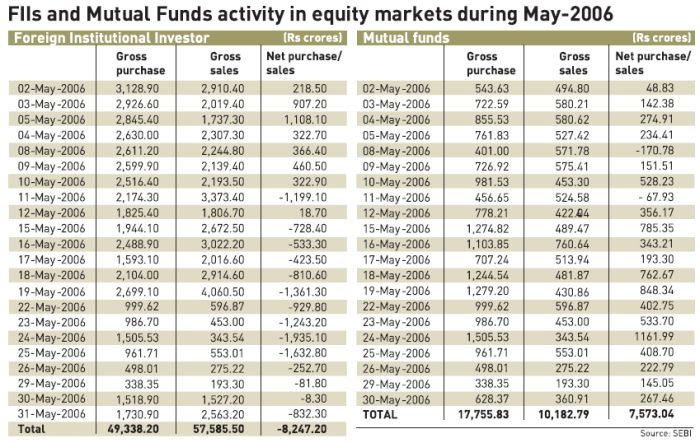
I'm no stock market expert, but look what Mutual Funds were upto during the recent (and indeed ongoing) Sensex 'correction', and all the bloodshed that followed. This could be an indication that in the long run, MF's and retail investors could actually support the market.

I am also convinced that behavioural economists probably do better at the stock market than those who follow scientific methods such as 'top down' or 'bottom up' stock picking. But then, I am no expert!

Source: Frontline's cover story

Sunday, June 11, 2006

Servant Leadership - another fad

The concept of Servant-Leadership was coined by Robert K. Greenleaf (1904-1990) in his essay The Servant as Leader.

Servant leadership is a form of leadership in which the leader desires to 'serve' first, and then assumes a leadership role by conscious choice. Greenleaf recommends that the simple mantra is to just 'serve' others in whatever situation you are faced with. Followers, while being served, become 'healthier, wiser, freer, more autonomous, more likely themselves to become servants themselves'.

The concept seems to boil down to "selfless service", not unlike what Indian philosophical texts have been recommending for thousands of years now! To me the whole concept of 'Servant leadership' seems more like a management fad than anything else. It seems to be a fresh articulation of leadership tenets that have existed for long. In fact most business books fall under this cateogory, possibly because modern managers don't read enough, and need to be spoon fed with easy to remember concepts in the form of 'The One Minute Manager', 'Principle Centred Leadership' and other such 'for dummies' books.

Signaling theory

An interesting post from a Fazeer's blog on economics, which I have been frequenting of late.

Monday, May 29, 2006

Published in The Hindu Business Line

Today, The Hindu Business Line (a leading mainstream business daily in India) carries an article written by me on decision making in groups. The article appears in page 10 of the main sheet.

Link to the article:
Why groups make bad decisions

You can send me feedback at mohit[dot]kishore[at]gmail[dot]com.

Saturday, May 27, 2006

Purpose before profit

I have earlier written on mission and vision statements here.
Now, read a similar post from Talentism that talks more about the importance of a clear 'purpose' for every business. Purpose before Profit.

Wednesday, May 24, 2006

Project Manager Leaves Suicide Powerpoint Presentation

Over time, managers tend to think in the form of Powerpoint presentations, bargain with shopkeepers keeping concepts like opportunity costs in mind, and use 2x2 matrices in their personal lives.
That eternally funny 'news' source - The Onion has this hilarious "story": Link
Project manager Ron Butler left behind a 48-slide PowerPoint presentation explaining his tragic decision to commit suicide, coworkers reported Tuesday. "When I first heard that Ron had swallowed an entire bottle of sleeping pills, I was shocked," said Hector Benitez, Butler's friend and coworker at Williams+Kennedy Marketing Consultants. "But after the team went through Ron's final PowerPoint presentation, I had a solid working knowledge of the pain he was feeling, his attempts to cope, and the reasons for his ultimate decision." "I just wish he would've shot me an e-mail asking for help," Benitez added.

Saturday, May 20, 2006

The importance of Mission/ Vision Statements

I don't know why companies do not give enough importance to their vision and mission statements. As organizations grow larger and larger, it is only the top management that has any clue about why the business exists in the first place. Employees lower down the hierarchy are unable to see the grand pattern in their mundane day to day activities. When employees find that the organization's goals are not in sync with their own personal goals (or when they have no clue about what the organizations's goals are) they start looking out for other jobs. People like to, and should, be part of causes which are larger than themselves. The employees at Google, are likely to strongly believe that what they do on a day to day basis will revolutionalize the way people view computing and technology. Check this link, to gain an insight into Google's corporate philosophy.

Vision statements and mission statements convey in a few words, what it is that the organization exists in the world for. Their brevity enables stakeholders to easily remember, imbibe and apply the tenets of the founding fathers of the organization. It also tells you in a few words whether or not an organization is for you or not. If a company's mission statement was - "To be the most ruthless widget manufacturer with the supreme goal of wiping out competition" - would you join it? Of course, I have to admit that most vision/ mission statements are really sugar coated and sound glorious. That is only because the people who are crafting them do not think the exercise will add any value to their organizations. They think it's more of a PR exercise for the benefit of the outside world.

If companies pay closer attention to the vision/mission statement, and tie organizational objectives to it, evaluate every step they take in terms of whether or not it will help them achive their mission, employees would be much happier. At least, they would have a clue about what the hell is going on, instead of just selling more of whatever it is that they sell.

Incidentally, the Balance Scorecard is one such approach where strategy flows from the organization's vision and is translated into four perspectives - financial, internal, customer and organizational development. It is inherently a good concept, and it probably works because most organizations rarely have a right brained vision/mission. They usually have a very quantified, market related definition of why they exist. With a left brained mission like "being number one in the market", a Balance Scorecard becomes like a simple execution roadmap for the same. It lacks that one key magic element - "passion".

Needless to say, just having a great mission/vision statment is only the first step. The next step is of course execution! This is done through rewarding employees who actively demonstrate the values of the company in their day to day dealings with other people.

Of course the job doesn't just end with Vision / Mission Statements. These statements must also flow in the values, which in turn flows into actual behaviours and organizational culture.

Read this new post for more on this topic.

Also check this post on Netflix's culture and values.

Friday, May 5, 2006

Calling for leaders who are geeks

Why business needs more geeks. Great post on why we need geeks in business too, and not just technology. I am reminded of the Apple ad that went "..because the people who are crazy enough to think they can change the world, are the ones who do.."

In that sense, the greatest leaders in the world - Gandhi, Mandela etc - have all had a geekish streak to them. They were not scared to try out new things and think unconventionally. Gandhi's non-violent struggle represents just the kind of stubborn idea that a geek can hold on to till he proves that it works. Gandhi's Dandi March was also a disruptive innovation. It was almost cinematic in its conceptualzation, the idea of thousands of Indians marching to Dandi to protest against the British salt tax.

On April 6th, Gandhi raised a lump of mud and salt (some say just a pinch, some say just a grain) and declared, "With this, I am shaking the foundations of the British Empire." He then boiled it in seawater to make the commodity which no Indian could legally produce—salt. [Wikipedia]

The world progresses through such unconventional people, who take tough stands.Similar to technology geeks, leader geeks also bring in disruptive innovations to the world. However, their innovations lie more in the space of politics and people management. When
Mangal Pandey sparked off the Revolt of 1857, he did not do it because he had some grand notions of freedom for mankind. He started on a rather minor issue (that of the cartridges in their guns having pig fat on them), and took a strong and unconventional position on it.

I think geeks in every sphere must be actively encouraged, instead of being treated like outcasts. A touch of the eccentric is what leads to innovations that are later termed great.

Tuesday, May 2, 2006

Idea sharing in organizations


Not surprising, since most organizations have a normal distribution oriented approach to performance measurement. In any normal distribution oriented place, people begin to think that the only way in which they can get ahead is at the expense of other people. Clearly, this is not a good environment for idea sharing.

I had read a book by Jerry Harvey called How Come Every Time I Get Stabbed in the Back My Fingerprints Are on the Knife? : And Other Meditations on Management, in which he talks about how he encourages his class to cheat on exams, therby ensuring that the quantity of 'good work' relative to bad work goes up. People inherently want to help each other, but in some environments (such as classrooms), this is referred to as cheating. Harvey turns this whole notion upside down. The following link gives a gist of Harvey's ideas.

The arts of impression management

Goffman, in his seminal book, The Presentation of Self in Everyday Life, proposes a dramaturgical perspective on impression management. He uses the metaphor of theatre to describe how people play different roles in different situations to create a desired impression.
However, such performances are often disrupted intentionally or unintentionally through unmeant gestures, inopportune intrusions, faux pas, and scenes.

The role of strategy in firms

My latest column for The Hindu Business Line explores the role of strategy in firms . Full text follows -- While there are many defini...