Showing posts with label Organizational Behaviour. Show all posts

Saturday, August 13, 2011

Enlighted Doership

My latest column for The Hindu Business Line: Enlightened Doer-ship
..

The presence of individual rewards in organisations presents an interesting problem. The ‘worker' in such a system is constantly drawn by two impulses, often at odds with each other — the first is the impulse to perform his duties effectively, and the second is to match his efforts towards the individual rewards on offer. This often leads to individual behaviours that are counter-productive to the larger goals and merely serve the short-term needs of individual rewards.
However, in reality all organisational accomplishment is possible only with the accomplishment of the collective, not an individual alone. Thus, an alternative view could be taken of the entire purpose of rewards, and the way to deliver them given the collective nature of organisational achievement. In this article, one such alternative approach is described.

ENLIGHTENED ‘DOER'-SHIP

The idea of enlightened doer-ship is based on two key ideas. The first idea is that the work is the primary reward in itself for the individual performing it.
In the absence of any individual reward other than the quality of work itself, one can expect people to focus purely on their creative energies being fully expressed through their work, and drop all other extraneous distractions.
The second feature of enlightened ‘doer'-ship is that results are measured purely on the basis of the achievement of the larger objective, and not individual contribution. This would ensure that detrimental behaviours such as credit seeking, unhealthy competition, and impression management would be eliminated. Success is defined purely at the level of a team, or a larger commune and not at the level of an individual. This ensures that all the horses drawing the cart, as it were, are doing so in the same direction and either everyone is rewarded or no one.
Enlightened ‘doer'-ship may at first sight seem to be an idealised state, where people believe the work itself is the reward, and constantly look at the larger organisational goal as a measure of performance. However, a deeper analysis will reveal that these are the two primary forces that lead to individual satisfaction.
The concept of monetary and non-monetary rewards for work is really a construct that admits that these two forces do not exist in the organisation.
And the reason why they don't exist is that the ‘design' of work and its rewards in complex, hierarchical systems places more importance on design simplicity, and management of egos than ideal solutions based on individual fulfilment.

DESIGNING A SYSTEM TOWARDS ENLIGHTENED DOER-SHIP

While enlightened doer-ship may appear to be a feature of an ideal society or organisation, there are ways to create a system based on this principle. Four key drivers can enable this change.
The first is the effective design of roles and the mapping of roles to the right people. Here, the first step is to ensure that each role is essentially one complete creative unit of the larger picture. The second step is to map the ‘meta' creative actions underlying that piece of work, with the capabilities of the person selected for the role. Achieving this first step also has another benefit — namely, a reduction in free riding on the part of individuals, given that all notions of rewards and success are linked to team performance (not individual performance). Once the right person is doing the right role, that is in synch with that person's creative impulse, the tendency to free ride would be minimal.
The second element of designing an enlightened doer-ship system would be a flat, functional hierarchy. Hierarchy, as applied today, has essentially become a form of reward. Superfluous levels are created in many organisations for no purpose other than to act as a reward to keep people motivated in the short term. The hierarchy in an enlightened doer-ship system would be essentially functional and contextual, and ‘permanent' levels would be created only where unavoidable. This means that the role of a leader in a group could potentially be played by different people in different contexts or assignments.
The third element is to ensure that all variable rewards are linked to performance at the level of the team or commune. Among other benefits, this will also ensure that all stakeholders are working towards the accomplishment of organisational goals first, followed by individual glory.
The fourth element is, of course, a receptive culture that values the entire concept. This may be the biggest challenge, and the transition period may be painful for an established organisation, given the degree of “unlearning” of past habits that would be required. For a start-up with a clean slate as it were, creating such a system would be relatively easier.

CONCLUSION

Enlightened doer-ship as described above is not intended to disregard talent or individual flair. All it does is dissociate talent and individual flair from the reward process. In other words, unless the larger goal is accomplished, no one in the collective is rewarded. And the individual is constantly rewarded for his individual flair on a day-to-day basis through his own work content. The path towards achieving this ‘enlightened' goal is a difficult one, and one that is made more complex given the scale of modern organisations, but is a path that must be taken, from the perspective of individual and organisational purpose fulfilment.
...
Older Columns:

Saturday, April 9, 2011

Building an Organizational Grammar

My latest column for The Hindu Business Line - Building an Organizational Grammar
Full text follows
--
The full potential of a language can be explored once a grammar systematises key patterns. The user can focus more on creating and communicating ideas and less on creating the structural means to do so.
Similarly, a formal grammar for organisations would enable them to focus greater energies on manifesting their purpose, without constantly reinventing the basic building blocks for doing so.
In this article an attempt is made to understand some of the conceptual units that could make up such a grammar.

Competencies and purpose

The first building block of the organisation is a collection of competencies or areas of expertise. This translates into an overarching purpose (or purposes) for the organisation. Purpose, as such, is an insight-driven discovery, but the insight is usually built upon the bedrock of manifest and un-manifest competencies.
Additionally, purpose is usually an overarching theme that may be able to successfully capture multiple dimensions of the competencies contained within the organisation. The glue that unites competencies with purpose is a shared vision.
The physical manifestation of competencies and purpose could take two forms. Firstly, it clearly influences the areas in which the firm will choose to operate in. Secondly, and, more importantly, it manifests in the choice of leaders who need to be fully aligned with both the competencies and purpose of the firm.

Platforms, Applications and Components

Platforms form the third building block of the organisational grammar. A platform essentially represents a market facing or internal facing proposition that the firm has to offer. A firm may have one or more platforms with possibly overlapping competencies and purposes. A product or service line is one example of a platform.
A platform is, in turn, a collection of one or more ‘applications'. Applications are fully functional, meaningful units, and can be replicated easily. For instance, an e-commerce application used by a firm in one service platform to distribute its products may easily be replicated across platforms.
A component would be small, repeatable units of competencies which may be contained within multiple applications. A component in isolation may not be meaningful, but creates value when it aggregates with other components. A collection of inter-related components would usually make up an application. Of course, components, in turn, may aggregate amongst themselves to form larger components. The linguistic equivalent of a component-application-component paradigm would be a word, sentence and paragraph.
In a really well-designed organisation, it will be evident that the very competencies and purpose that form the first building block of the grammar are found even in the smallest components, applications and platforms in the firm. This is not unlike a fractal, and its feature of ‘self-similarity'.

Applications of a Grammar

A clear understanding of the grammatical elements available in an organisation can become an important guide to actually designing the structure of the firm. Often, one finds firms where components are embedded so deeply into applications and platforms that they aren't well understood outside them, leading to frequent attempts at reinventing the wheel. Organising around grammatical elements will ensure that everything that is created in the organisation finds its full expression. Knowledge management would be a critical element in a ‘grammatically structured' organisation, in order to ensure that component level expertise is consolidated centrally and redeployed as required.

The second arena in which a grammatical element based approach helps is in the identification of talent to place into those elements. While some people are component level thinkers, others may think at a platform level, and still others may excel in conceptualising visions of future states.

A third area in which a grammar-based approach helps is the effective design of conglomerates which operate in multiple spaces, while operating within its overarching purpose or competency areas. Too often one comes across cases of destructive diversification that have nothing to do with the competency-purpose-platform skills of the parent firm. 

While this is only a brief attempt at visualising what a formal grammar for firms might look like, it is not difficult to see that a clear, well-tested grammar may have a lot of applications that help organisations fully utilise their creative energy, with both market-facing ramifications (increased revenue, etc,) and internal implications such as enhanced fulfilment.

--
Previous Columns:


Sunday, January 30, 2011

Organizational Culture Change

Check out my latest article at The Hindu Business Line - Organizational Culture Change. Full text follows:
____
The changing culture is a complex problem faced by many organisations. It's a lot like repairing the engine of a moving vehicle. While new firms have the luxury of gradually building the culture that best serves their interest, larger organisations tend to find themselves ‘stuck' with cultures that may be completely at odds with their stated vision or strategy. The big question then is whether it is possible to change culture mid-course. The answer may lie in understanding how culture is created in the first place.

Individual & organisational values

The crux of culture is values — in simple terms values expressed in the form of behaviours is what is perceived as culture. Values themselves may be of two kinds — individual and organisational.
The source of organisational values is usually the values of the founders. However, with time, as the firm transitions the values could change. This could be due to a lack of attention paid to the developing culture, particularly when meeting the demands of rapid growth. This takes the form of indiscriminate addition of individuals whose values may be at odds with the founding values. While organisational values may be documented formally, the ‘real' organisational values are informally “stored” in the minds of members of the organisation. 

Individual values may be of two kinds — expressed, and suppressed. Expressed values are those that members of an organisation choose to express in their behaviour based on their assessment of what is required in the organisation or ‘what works'. The other values possessed by an individual member may be suppressed, at least in the organisational context. It is this interplay between “stored” organisational values and individual values that develops into “culture” in the manifested form. The metaphor of an iceberg could represent this interplay. What is seen above the surface is culture, but what lies beneath is the cause — the complex, ever-evolving dynamic of organisational and individual values.

The right culture

The next question that arises is — what is the right kind of culture for a particular organisation. The simple answer to this would be — the culture in which there is no conflict between organisational and individual values, and where organisational values themselves are aligned to what the organisation seeks to achieve. It is important to recognise that the culture manifested at any time is indeed already the most appropriate culture for the current interplay between organisational and individual member values.However, this culture may happen to be completely counter-productive to the organisational goals, owing to degraded organisational values or high conflict between individual and organisational values. Any attempt to transform culture by simply manipulating the manifest dimension of culture will not succeed unless the underlying interplay of values is not addressed. 

Thus, culture transformation must address both organisational and individual values. On the organisational values front, one may first need to begin with an assessment of what the organisation's values really are. If the current state of values is a diluted version of the original intent, a fresh rediscovery or redefinition of values may need to take place in order to define an ideal state.

On the individual values front, the first intervention should be at the ‘input' stage, where new members are inducted. If a well-defined organisational identity or value is in place, it is not difficult to identify and add individuals who are in alignment. The bigger challenge is for existing members. Here, the solution is likely to be a more gradual one. It may involve a reassessment of all levels in the hierarchy to determine the “culture” icons best suited for leadership roles in the “new world” as it were. Leadership roles are the key fulcrums upon which culture is reinforced. This is because leadership behaviours typically tend to activate the relevant values in followers (provided the followers subscribe to those values at least partially). Over time, a culture transformation process would start to work on the organisation's memory, replacing negative versions of the organisation's values that are “stored” in the minds of members with fresh versions, till the new version becomes the new normal.

Setting right a malfunctioning or poorly aligned organisational culture is undoubtedly a complex process and may require an intuitive, right-brained mindset on the part of the designers, as well as multiple iterations to arrive at the right solution.Finally, culture needs to be an integral component of organisational strategy, as it is the foundational building block upon which the organisation's purpose can be manifested into reality. 
----
Some older columns:

Wednesday, May 19, 2010

Organizations as fulfilment engines

My latest piece for The Hindu Business Line - Organizations as fulfilment engines
Full text follows:

What is the true purpose of an organisation? Is it merely the creation of wealth, or must there be a higher purpose to it? The East may have some answers to this question.Indian culture, as a result of its philosophical foundations in Vedic traditions, has never eschewed wealth. However, it has repeatedly stressed that the real purpose of life is a higher fulfilment whose end goal is self-realisation.Thus, material wealth of any form cannot become the end of any enterprise or human life. It may certainly be one of the outcomes, but is not the central purpose.Our institutions in all spheres - be it business, education or Government - seem to be losing sight of the higher purpose of their existence and have increasingly started viewing themselves as a means to an end. What then could be the higher purpose that an institution must seek to address itself to?

While there could be many ways of looking at this issue, one possible answer is that the reason for the existence of any institution is to provide an arena for fulfilment for its end-users (customers) and constituents (employees and other stakeholders).What might such a fulfilment-centred organisation look like across these two dimensions of external and internal stakeholders?

CUSTOMER FULFILMENT
The big question here is - which customer purpose is this organisation trying to fulfil? Unfortunately, the industrial era mindset is one of viewing customers as being no more than `wallets' waiting to be tapped. This is not to suggest that such firms are unethical - they are only responding to shareholder and investor expectations by behaving in a manner that only focuses on financial goals.Additionally, given the complexity of large organisations and the degrees of separation between the producers and end-consumers, it is no surprise that organisations view customers as abstractions.

The post-industrial world needs to view customers and their needs in the light of purpose fulfilment. Every customer is essentially seeking fulfilment of some sort through the consumption of goods and services. This fulfilment could be at a basic level of survival, or at the highest level of self-actualisation.

What if a business organisation were to align itself to this hierarchy of needs and claim as its mission the goal of raising the customer to higher levels of fulfilment? This may mean the creation of increasingly sophisticated products for which there may not be a market at the moment. The exact opposite of this is seen in many privately- owned electronic news media outlets. In the interest of `what sells', these outlets cater to the lowest in their `customers' instead of raising the bar to challenge their customers to evolve. They need to realise that producers of goods and services have a moral responsibility towards customers. In fact, this is a far higher form of corporate social responsibility than the contribution of a share of profits towards social causes.

THE INTERNAL PERSPECTIVE
Within the organisation two axes of fulfilment must be clearly defined - the first is the fulfilment of customers through the work done by a worker, and second is the fulfilment of the worker himself, and the two reinforce each other. However, as pointed out earlier, the distance from the actual customer, and the abstract way in which tasks are parcelled out means that the average worker no longer feels connected to the customer's purpose or even his own purpose.The way out of this alienation is to erase the boundaries between the firm and its customers, and allow customers to `infiltrate' with their views and allow these to actively influence corporate strategy.

The second dimension i.e. the worker's own fulfilment. This involves a systemic reevaluation of how careers are viewed from the traditional give-and-take transactional model to a fulfilment-oriented model. In the latter model, a service mindset (seva) will be very important. Seva, in the Vedic/ karma yoga context, is a work offered without any anticipation of reward, because the work itself is the reward in that it offers an opportunity to expand oneself from one's narrow selfish ego, towards a greater humanity.While this may seem like lofty idealism, it is easy to see its practical function. Activities performed without anticipation or anxiety for future rewards must necessarily bring greater focus to the work at hand, and hence, a greater quality in the outcome, as well as greater fulfilment.

In conclusion, India is well placed due to its unique cultural and historical context to bring alive the vision of fulfilment-centric organisations. The question then is whether we will choose to replicate the path taken by the West and its attendant pitfalls, or will we at some point integrate the best of the East with the West.

--------
Older pieces:

Tuesday, March 23, 2010

Organizational memory and change

My latest column for The Hindu Business Line - Organizational memory and change. Full text follows.

Memory plays an important role in a human being's tendency to change. As a person experiences more, he creates more memories and as a result becomes a product of his memories.In a similar manner, organisations too have memories which are essentially the sum total of experiences of the current members. While these collections of memories or knowledge are certainly useful in building and scaling expertise contained within the organisation, they often become impediments to change.Such organisations find themselves with a ‘culture' that is unsupportive to change and prefers old habits that are unproductive and safe. The only exceptions are tipping point situations where the cost of holding on to memories becomes far greater than the benefits of change.In the face of such situations, some organisations finally reinvent themselves, while others just become extinct or fade away.Another point to be considered is that even in such extreme situations the change process is designed in a top-down way, and thus there is an inevitable resistance through the levels within the organisation, making it all the more difficult to create change when it is most needed.

Designing organisations for change
The question then is whether change can actually be designed to occur well before such extreme situations. The best way to go about achieving this would be the creation of decentralised change protocols at the micro level ‘sub-systems' within the organisational system. This is because the idea of change is closely linked to the idea of ‘spontaneity', or the ability to respond to a situation without stopping to consider the past (memories) or future.It can easily be observed that within sub-systems, the ability to be spontaneous is far higher than within a complex system as a whole. This is because sub-systems have far fewer moving parts, and as a result are able to quickly change to meet new demands. How then can an organisation be designed in such a way that its smaller sub-systems embrace change?

Decentralisation & capacity building
Decentralisation: As organisations get larger, there is a strong tendency to centralise all protocols for change. This leads to tedious bureaucratic processes of ‘approvals' and over-analysis which inevitably quell not just the proposed change initiative but reduce the tendency for future such attempts.Thus, the first key is to decentralise the origination and execution of change initiatives almost entirely to the sub-systems. There would still be ‘rules' to be followed, but these would be known in advance.

Building capacity for change:
The immediate criticism of the first suggestion is that too much decentralisation may lead to excessive risk-taking or poorly thought out initiatives that fail to take into account the larger impact of the changes in the sub-system on the system as a whole.Thus, the second key is to actually build capacity within the sub-systems so that there is a deep understanding of how changes within the sub-system impact different parts of the larger system, as well as the ‘whole' of the system. This capacity could be built into individual change agents within each sub-system.

Emergent change
From the foregoing discussion it may appear that the entire process of change can only be autonomous at the micro level, and not at the macro level as a whole. However, one may argue that the best change for any organisation is the sum total of the spontaneous changes in all its sub-systems.

In other words, if the mechanisms for rapid, spontaneous change are embedded into sub-systems, there is no need to worry about the system as a whole. It will automatically reach the place where it needs to be.
Thus, change at the level of a system is essentially an emergent property of change at the levels of the sub-systems. As such, there may be no need to be too concerned about where the system as a whole is headed as long as the sub-systems have the required capacity to design and execute change. In such a situation, the only ‘central' role in the organisation as far as change initiatives are concerned would be the design of efficient and simple change protocols for the sub-systems, as well as capacity building to understand the impact of sub-system change on the system as a whole.

In summary, any process of change is dependant on the capacity of an organisation to temporarily discard its memories in favour of spontaneous responses to the environment. However, in most organisations, particularly the large ones, this process can happen easily only at the sub-system level. The key then is to ensure that there is adequate intelligence built into all these smaller units that make up the organisation, while believing that the sub-systems' process of change will automatically result in the evolution of the system as a whole for the better.
---
Links to older columns:

Monday, October 12, 2009

Three skills

Seth Godin has an interesting post on what he believes to be the three skill areas that ensure you are in demand as an employee:
  • Sales
  • Additive effort (someone who brings in efficiencies)
  • Initiation (someone who can initiate action... or start something transformational)
I think the three skill areas can be re-articulated as follows:
  1. Someone who can increase revenue
  2. Someone who can reduce cost
  3. Someone who can bring creative ideas to life or create new wealth creating assets.
Seth rightly points out that the last skill is difficult to value. The first two are directly P&L oriented, while the last one is more fuzzy and takes time to enter the P&L, and is also prone to failure i.e. ( a lot of entrepreneurial initiatives tend to fail or fizzle out) .

Tuesday, August 11, 2009

Netflix culture and values

Here's an interesting internal presentation from Netflix on their company culture and values.

Among other things, the presentation argues that in order to preserve a high level of freedom as the organization transitions from start up mode to large organization mode, the organization will actually hire more and more star performers. In other words, you maintain freedom by hiring more responsible people who are good performers. I don't see how that is practical. A ten employee company can easily hire 2-3 stars and increase head count by 20-30%. However, a 1000 employee company would need to find 200-300 stars in the market place in order to maintain its star ratio as it were. This seems quite hard to do.

Monday, October 13, 2008

Organization Culture as an Emergent Phenomenon

My latest column for The Hindu Business Line is entitled Organization Culture as an Emergent Phenomenon.

The full text follows:

Emergence is a phenomenon that has been studied in many disciplines and it refers to the way complex systems and patterns arise out of a multiplicity of relatively simple interactions with no central coordination. Emergence is seen in systems such as nature, stock markets, traffic patterns and organisations. For instance, an ant hill is an emergent structure created by hundreds of ants, each of which is engaged in a particular kind of activity without being aware of the re sultant structure. Similarly, complex flocking patterns amongst birds actually emerge out of simple behaviours on the part of individual birds (such as trying not to collide with other birds while still being part of the flock). In other words, the emergent structure is more than just the sum of the parts. In this article I propose two ideas — first, that organisational culture is an emergent phenomenon and second, that ‘values’ are the underlying ‘simple rules’ governing culture.

An emergent reality

It is possible to view organisational culture as an emergent outcome of the countless interactions that take place between the various constituents of an organisation. Each participant is not aware of his contribution to the overall emergent culture, and behaves in an independent manner in all situations based on his own personal beliefs.

If this is the case, it would appear that it is very hard to ‘control’ what kind of culture may emerge in a given organisation as the behaviour of individuals is hard to predict. How then does one go about creating a particular kind of culture? The answer may lie in our understanding of emergent systems as being an outcome of individual agents acting on the basis of simple rules. When these rules are executed by a large number of participants, an emergent structure presents itself. Extending this to an organisational scenario, if a few simple rules were to be set that governs all interactions of an organisation’s members, the emergent reality — in this case organisational culture — can be managed to produce favourable end states.

Role of values

Most organisations already have the building blocks for this simple set of interaction rules in the form of ‘company values’. The only problem though is that company values are not designed keeping in mind their potential to influence culture. Some values tend to be based on universal morals such as ‘integrity’, while others, like ‘passion’, have no links to day-to-day behaviour.

An organisational value should ideally have two characteristics — specificity or uniqueness and linkage to behaviour. Specificity means that a value should be unique and based on the specific organisation under consideration. Secondly, values must be behaviour linked; they must clearly imply what kind of actions someone would need to perform to adhere to them. Of course, all universal values continue to operate regardless of whether or not they are an ‘official’ value. MindTree is a good example of a company with both unique as well as behaviour-linked values. Caring, learning, achieving, sharing and social responsibility are the values of this company (many surveys have rated it among the best employers).


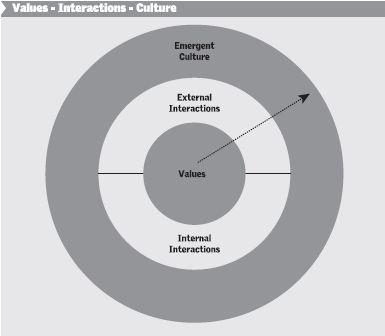
Values-Interactions-Culture

The resulting model would be as depicted in the accompanying figure. At the heart of the model are values — these are to be very carefully determined by the leadership of the organisation and periodically reassessed. These values form the basis of countless interactions between members themselves, and between members and other stakeholders such as customers.

The resultant emergent phenomenon would be the organisational culture. In order to foster a strong link between values and actual behaviour, reward systems must be aligned to incentivise demonstration of values.

Finally, it must be recognised that well ‘designed’ values help to actualise the ‘unique goodness’ of an organisation through the creation of an enabling culture, which in turn ensures that people who intend to contribute meaningfully are not hindered in any way from doing so.

------------

Older columns are as follows:

Thursday, April 5, 2007

Emergence

I read about this interesting concept today.

Emergence is one of the founding principles of agility, and is the closest one to pure magic. Emergent properties aren't designed or built in, they simply happen as a dynamic result of the rest of the system. "Emergence" comes from middle 17th century Latin in the sense of an "unforeseen occurrence." You can't plan for it or schedule it, but you can cultivate an environment where you can let it happen and benefit from it.

A classic example of emergence lies in the flocking behavior of birds. A computer simulation can use as few as three simple rules (along the lines of "don't run into each other") and suddenly you get very complex behavior as the flock wends and wafts its way gracefully through the sky, reforming around obstacles, and so on. None of this advanced behavior (such as reforming the same shape around an obstacle) is specified by the rules; it emerges from the dynamics of the system.

Link via 37signals. Source: Andrew Hunt - The pragmatic programmers.

Sometimes the best ways to create complex outcomes is to create simple mantras to be followed religiously by all stakeholders.

The concept can be extended to organizations as a whole. If an organization has 3-5 pithy mantras that it will abide by in all its decisions, it can lead to complex positive outcomes. On the other hand if one were to start from the complex outcome and work backwards, failure is guaranteed. I believe that great vision statements perform this function in aligning the actions of organizational stakeholders.

Saturday, January 27, 2007

Anecdote

I have always believed in the importance of narrative, and stories in organizations. Sometimes, these narratives assume even more importance than logical/efficient decision making. A typical example is the commonly heard "this is how we do things here". I found an interesting blog that is dedicated to such stuff - Anecdote. Anecdote is a consulting firm that works in this niche area.

Here's an interesting post from Anecdote - the difference between a sound argument and a good story

Bruner called the two modes of thought ‘logico-scientific’ (or paradigmatic) and ‘narrative’, arguing that:

the types of causality implied in the two modes are palpably different. The term then functions differently in the logical proposition ‘if x, then y’ and in the narrative recit ‘The king died, and then the queen died.’ One leads to a search for universal truth conditions, the other for likely particular connections between two events – mortal grief, suicide, foul play. (pp. 11–12)

To compare the two modes, Bruner claimed, is to understand the difference between a sound argument and a good story.

Monday, October 30, 2006

Free Riding and Social Loafing [featured in The Hindu Business Line]

Today's Hindu Business Line carries the following article by me.

Link to the article: Free Riding and Social Loafing. Full text follows:

Free riding is a problem that is commonly found in almost all organisational contexts. With most tasks being accomplished by teams, it is quite common for a few members to slack off and not contribute to the team's cause, and yet not have the results suffer. As an economic phenomenon free riding has been studied for a long time.

A simple definition of a free rider is an agent who does not contribute his fair share to the cost of production of a resource, but receives an equal share of the benefits.

A simple example of this is taxation. Monies collected through taxes are deployed in various projects such as improving infrastructure, healthcare and so on.

Yet, a lot of people get away with paying no tax and still continue to reap the benefits of using those resources. The free riding problem is actually an `n-player' version of the famous `prisoner's dilemma', where `n' is greater than two. Where only two players are playing, non-fulfilment of one player's contribution would amount to the project being abandoned. However, when `n' is greater than two, it is possible for some players to not contribute, while hoping that others do.

Another interesting example of the free riding problem is the recent reservation protests in India.

Most protestors felt that while the general category of students would have to work really hard for the coveted few seats in the premier institutions, the reserved category would have it much easier without contributing enough (in terms of effort). Of course, those in favour of reservation could argue that the reserved categories have actually made up for this through the socio-economic suffering and discrimination they have faced.

Social Loafing
Related to the concept of free riding is that of social loafing. Social loafing refers to a situation where an individual holds back his contribution because he perceives that he would not be getting a fair share of the rewards in the eventuality of success, nor would he be blamed for failure. In an experiment by French engineer Maximilian Ringelmann, involving a group of people tugging on a rope, it has been seen that as the number of people increases, the total force exerted also increases, but the average force per person is seen to diminish.

The key difference between free riding and social loafing is that a free rider does not contribute to the cause at all, since his contribution is not essential for success, whereas a social loafer merely reduces his effort fully knowing that it would be impossible for an external observer to determine the same.

Dealing with free riding and social loafing
The Ringelmann experiment suggests that the size of the group may have some answers to offer us. A good manager may need to precisely identify the number of people it would require to successfully accomplish a task. Second, social loafing is seen in situations where it is impossible to identify individual contribution.

Thus, a good way to prevent it may be to clearly define the individual's role in the group task. Third, it is seen that social loafing does not present a major problem in cohesive teams (the reason being that team members value their affiliation with the group more than any benefits associated with social loafing). Thus, the choice of specific team members for a task may also help in minimising social loafing.

Task significance may also have a role to play in increasing motivation levels to perform. Task significance refers to the relevance of the task to the immediate organisation, group, society or the world at large.

One suspects that social loafing may be a less common phenomenon in an NGO, compared to other types of organisations.

Reward systems
Reward systems such as stock options and performance bonuses too increase the cost of not contributing, as non-contribution would directly lead to reduced benefits for the individual team member. Thus, each team member would at least contribute in his own self interest.

This is, in fact, not unlike Adam Smith's theory of the `invisible hand' of the economy, where each individual agent does whatever is in his self interest, and this somehow leads to a beneficial collective result, which is quite different from what the individual expects. Both free riding and social loafing are phenomena that are seen in all kinds of organisations — companies, families, communities, neighbourhoods, governments and so on. It is thus not surprising to find Glaucon arguing (many centuries ago ) in Plato's Republic that an individual need not obey the law in situations where he can escape the consequent sanctions!

(The writer, an alumnus of XLRI, is working with a multinational financial services company)

Saturday, May 20, 2006

The importance of Mission/ Vision Statements

I don't know why companies do not give enough importance to their vision and mission statements. As organizations grow larger and larger, it is only the top management that has any clue about why the business exists in the first place. Employees lower down the hierarchy are unable to see the grand pattern in their mundane day to day activities. When employees find that the organization's goals are not in sync with their own personal goals (or when they have no clue about what the organizations's goals are) they start looking out for other jobs. People like to, and should, be part of causes which are larger than themselves. The employees at Google, are likely to strongly believe that what they do on a day to day basis will revolutionalize the way people view computing and technology. Check this link, to gain an insight into Google's corporate philosophy.

Vision statements and mission statements convey in a few words, what it is that the organization exists in the world for. Their brevity enables stakeholders to easily remember, imbibe and apply the tenets of the founding fathers of the organization. It also tells you in a few words whether or not an organization is for you or not. If a company's mission statement was - "To be the most ruthless widget manufacturer with the supreme goal of wiping out competition" - would you join it? Of course, I have to admit that most vision/ mission statements are really sugar coated and sound glorious. That is only because the people who are crafting them do not think the exercise will add any value to their organizations. They think it's more of a PR exercise for the benefit of the outside world.

If companies pay closer attention to the vision/mission statement, and tie organizational objectives to it, evaluate every step they take in terms of whether or not it will help them achive their mission, employees would be much happier. At least, they would have a clue about what the hell is going on, instead of just selling more of whatever it is that they sell.

Incidentally, the Balance Scorecard is one such approach where strategy flows from the organization's vision and is translated into four perspectives - financial, internal, customer and organizational development. It is inherently a good concept, and it probably works because most organizations rarely have a right brained vision/mission. They usually have a very quantified, market related definition of why they exist. With a left brained mission like "being number one in the market", a Balance Scorecard becomes like a simple execution roadmap for the same. It lacks that one key magic element - "passion".

Needless to say, just having a great mission/vision statment is only the first step. The next step is of course execution! This is done through rewarding employees who actively demonstrate the values of the company in their day to day dealings with other people.

Of course the job doesn't just end with Vision / Mission Statements. These statements must also flow in the values, which in turn flows into actual behaviours and organizational culture.

Read this new post for more on this topic.

Also check this post on Netflix's culture and values.

The role of strategy in firms

My latest column for The Hindu Business Line explores the role of strategy in firms . Full text follows -- While there are many defini...