Thursday, June 15, 2006

Google versus Microsoft, and the Henry Ford trap

Google and Microsoft differ fundamentally in their views on Office applications. While Google is all for having the application residing on a server, with the user accessing and using it through a thin client (browser), Microsoft believes in the traditional notion of having the application reside on your hard disk. [read about Google Spreadsheet]

In the medium term, with bandwidth being an issue, apart from the fact that there is only so much you can do inside a browser, I expect Microsoft to win the Office battle. In the long run too, with cheap hard disk space and cheap processors, I do not see much benefit in a browser based Office suite. One benefit that I forsee is that collaborative editing (example, Writely) may really take off (people in remote locations editing the same document over the Internet), but I am sure the guys at Microsoft will find a way to include collaborative editing within Office.

Is Google falling into the Ford trap ('People can have the Model T in any color - so long as it's black.') with it's insistence on developing applications that reside in the browser? Time will tell, but my hunch is yes.

Wednesday, June 14, 2006

Reward loyalty or performance?

All organizations reward members for loyalty. I am wondering whether this is the right strategy, particularly when loyalty is not accompanied by performance. Is retention such a high priority that organizations would like to keep people (even bad ones) at any expense? The answer may lie to a small extent in the realm of emotions. An employee who has stuck around for long with a company is likely to have a strong sense of affiliation to it, and is likely to serve the organization favourably in his decision making and performance (even if it isn't peak performance). It probably pays to have such people with you, rather than those who crib at every opportunity, and may jump ship any day. Secondly, and more importantly, rewarding loyal employees may also help to serve as a signal to good performers that hints at what their own future might be like. The question here is whether the signal may actually fail, if good performers begin to think that loyalty assumes precedence over performance.

My personal view on this is that only performance must be rewarded. Rewarding loyalty, purely as a symbolic measure is just going to be that - symbolic - and not greatly beneficial. Moreoever, rewarding performance is likely to increase loyalty of good performers, thereby leading to a virtuous cycle. Productivity in goverment offices gives us a hint of what happens in organizations that only look at loyalty at the expense of performance.
----
Nirav, points out an interesting example of a reward system that combines loyalty and performance - stock options! You get them only if you stick around, and you reap the benefits only if your company does well (which indirectly means that you have to contribute to the cause).

Monday, June 12, 2006

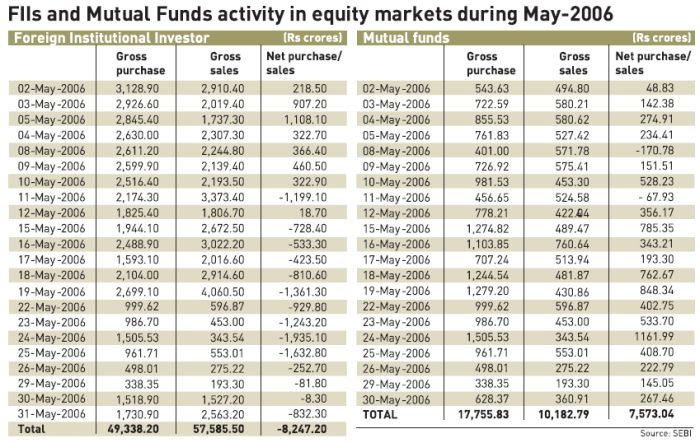
The Stock market - Could Mutual Funds support the market in some distant time in the future?

I'm no stock market expert, but look what Mutual Funds were upto during the recent (and indeed ongoing) Sensex 'correction', and all the bloodshed that followed. This could be an indication that in the long run, MF's and retail investors could actually support the market.

I am also convinced that behavioural economists probably do better at the stock market than those who follow scientific methods such as 'top down' or 'bottom up' stock picking. But then, I am no expert!

Source: Frontline's cover story

Sunday, June 11, 2006

Servant Leadership - another fad

The concept of Servant-Leadership was coined by Robert K. Greenleaf (1904-1990) in his essay The Servant as Leader.

Servant leadership is a form of leadership in which the leader desires to 'serve' first, and then assumes a leadership role by conscious choice. Greenleaf recommends that the simple mantra is to just 'serve' others in whatever situation you are faced with. Followers, while being served, become 'healthier, wiser, freer, more autonomous, more likely themselves to become servants themselves'.

The concept seems to boil down to "selfless service", not unlike what Indian philosophical texts have been recommending for thousands of years now! To me the whole concept of 'Servant leadership' seems more like a management fad than anything else. It seems to be a fresh articulation of leadership tenets that have existed for long. In fact most business books fall under this cateogory, possibly because modern managers don't read enough, and need to be spoon fed with easy to remember concepts in the form of 'The One Minute Manager', 'Principle Centred Leadership' and other such 'for dummies' books.

Signaling theory

An interesting post from a Fazeer's blog on economics, which I have been frequenting of late.

Monday, May 29, 2006

Published in The Hindu Business Line

Today, The Hindu Business Line (a leading mainstream business daily in India) carries an article written by me on decision making in groups. The article appears in page 10 of the main sheet.

Link to the article:
Why groups make bad decisions

You can send me feedback at mohit[dot]kishore[at]gmail[dot]com.

Saturday, May 27, 2006

Purpose before profit

I have earlier written on mission and vision statements here.
Now, read a similar post from Talentism that talks more about the importance of a clear 'purpose' for every business. Purpose before Profit.

Wednesday, May 24, 2006

Project Manager Leaves Suicide Powerpoint Presentation

Over time, managers tend to think in the form of Powerpoint presentations, bargain with shopkeepers keeping concepts like opportunity costs in mind, and use 2x2 matrices in their personal lives.
That eternally funny 'news' source - The Onion has this hilarious "story": Link
Project manager Ron Butler left behind a 48-slide PowerPoint presentation explaining his tragic decision to commit suicide, coworkers reported Tuesday. "When I first heard that Ron had swallowed an entire bottle of sleeping pills, I was shocked," said Hector Benitez, Butler's friend and coworker at Williams+Kennedy Marketing Consultants. "But after the team went through Ron's final PowerPoint presentation, I had a solid working knowledge of the pain he was feeling, his attempts to cope, and the reasons for his ultimate decision." "I just wish he would've shot me an e-mail asking for help," Benitez added.

Saturday, May 20, 2006

The importance of Mission/ Vision Statements

I don't know why companies do not give enough importance to their vision and mission statements. As organizations grow larger and larger, it is only the top management that has any clue about why the business exists in the first place. Employees lower down the hierarchy are unable to see the grand pattern in their mundane day to day activities. When employees find that the organization's goals are not in sync with their own personal goals (or when they have no clue about what the organizations's goals are) they start looking out for other jobs. People like to, and should, be part of causes which are larger than themselves. The employees at Google, are likely to strongly believe that what they do on a day to day basis will revolutionalize the way people view computing and technology. Check this link, to gain an insight into Google's corporate philosophy.

Vision statements and mission statements convey in a few words, what it is that the organization exists in the world for. Their brevity enables stakeholders to easily remember, imbibe and apply the tenets of the founding fathers of the organization. It also tells you in a few words whether or not an organization is for you or not. If a company's mission statement was - "To be the most ruthless widget manufacturer with the supreme goal of wiping out competition" - would you join it? Of course, I have to admit that most vision/ mission statements are really sugar coated and sound glorious. That is only because the people who are crafting them do not think the exercise will add any value to their organizations. They think it's more of a PR exercise for the benefit of the outside world.

If companies pay closer attention to the vision/mission statement, and tie organizational objectives to it, evaluate every step they take in terms of whether or not it will help them achive their mission, employees would be much happier. At least, they would have a clue about what the hell is going on, instead of just selling more of whatever it is that they sell.

Incidentally, the Balance Scorecard is one such approach where strategy flows from the organization's vision and is translated into four perspectives - financial, internal, customer and organizational development. It is inherently a good concept, and it probably works because most organizations rarely have a right brained vision/mission. They usually have a very quantified, market related definition of why they exist. With a left brained mission like "being number one in the market", a Balance Scorecard becomes like a simple execution roadmap for the same. It lacks that one key magic element - "passion".

Needless to say, just having a great mission/vision statment is only the first step. The next step is of course execution! This is done through rewarding employees who actively demonstrate the values of the company in their day to day dealings with other people.

Of course the job doesn't just end with Vision / Mission Statements. These statements must also flow in the values, which in turn flows into actual behaviours and organizational culture.

Read this new post for more on this topic.

Also check this post on Netflix's culture and values.

Friday, May 5, 2006

Calling for leaders who are geeks

Why business needs more geeks. Great post on why we need geeks in business too, and not just technology. I am reminded of the Apple ad that went "..because the people who are crazy enough to think they can change the world, are the ones who do.."

In that sense, the greatest leaders in the world - Gandhi, Mandela etc - have all had a geekish streak to them. They were not scared to try out new things and think unconventionally. Gandhi's non-violent struggle represents just the kind of stubborn idea that a geek can hold on to till he proves that it works. Gandhi's Dandi March was also a disruptive innovation. It was almost cinematic in its conceptualzation, the idea of thousands of Indians marching to Dandi to protest against the British salt tax.

On April 6th, Gandhi raised a lump of mud and salt (some say just a pinch, some say just a grain) and declared, "With this, I am shaking the foundations of the British Empire." He then boiled it in seawater to make the commodity which no Indian could legally produce—salt. [Wikipedia]

The world progresses through such unconventional people, who take tough stands.Similar to technology geeks, leader geeks also bring in disruptive innovations to the world. However, their innovations lie more in the space of politics and people management. When
Mangal Pandey sparked off the Revolt of 1857, he did not do it because he had some grand notions of freedom for mankind. He started on a rather minor issue (that of the cartridges in their guns having pig fat on them), and took a strong and unconventional position on it.

I think geeks in every sphere must be actively encouraged, instead of being treated like outcasts. A touch of the eccentric is what leads to innovations that are later termed great.

Tuesday, May 2, 2006

Idea sharing in organizations


Not surprising, since most organizations have a normal distribution oriented approach to performance measurement. In any normal distribution oriented place, people begin to think that the only way in which they can get ahead is at the expense of other people. Clearly, this is not a good environment for idea sharing.

I had read a book by Jerry Harvey called How Come Every Time I Get Stabbed in the Back My Fingerprints Are on the Knife? : And Other Meditations on Management, in which he talks about how he encourages his class to cheat on exams, therby ensuring that the quantity of 'good work' relative to bad work goes up. People inherently want to help each other, but in some environments (such as classrooms), this is referred to as cheating. Harvey turns this whole notion upside down. The following link gives a gist of Harvey's ideas.

The arts of impression management

Goffman, in his seminal book, The Presentation of Self in Everyday Life, proposes a dramaturgical perspective on impression management. He uses the metaphor of theatre to describe how people play different roles in different situations to create a desired impression.
However, such performances are often disrupted intentionally or unintentionally through unmeant gestures, inopportune intrusions, faux pas, and scenes.

Thursday, April 27, 2006

Prospect Theory

Although, I had read about this theory some time back, it has suddenly captured my interest again. The Prospect Theory came out of the work of two psychologists - Kahneman and Tversky - to explain why people make decisions that conflict with the Expected Utility Theory. To put it in simpler terms, the theory tries to explain why people behave irrationally in the face of choices.
The expected utility hypothesis is the hypothesis that the utility of an agent facing uncertainty is calculated by considering utility in each possible state and constructing a weighted average. The weights are the agent's estimate of the probability of each state.

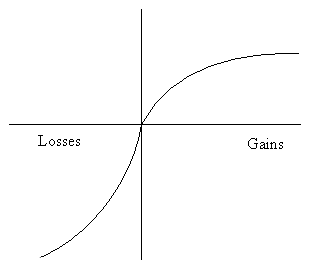
The crux of the prospect theory is this: We have an irrational tendency to be less wil
ling to gamble with profits than with losses. This means selling quickly when we earn profits but not selling if we are running losses. [Tvede 1999]. This can be represented by a value function as shown on the right. As shown, losses hurt more than gains satisfy.

The key difference between the two theories is that the expected utility hypothesis describes how people should behave (prescriptive) when faced with choices, while the prospect theory aims to describe how people actually behave (descriptive).

Simple enough isn't it? But consider the implications:
  • People hold on to stocks that have taken a beating hoping that they would go up some day
  • People tend to sell off stocks sooner when they are going up - (leading to frequent stock market "corrections" as TV channels put it)
  • People place a higher value on something they own, when compared to the same thing if they didn't own it. (People prefer certain gains)
  • Your boss is more likely to approve your application for leave if it is in the form of a series of applications for 2 days each every 20 days over a 60 day period as opposed to a stretch of 6 days at a time.
  • A person who owns an apartment will estimate its market rate (for rent) to be higher than what he would pay were he to take it on rent himself.
The prospect theory is all around you. Look out for it.

More about prospect theory.

Tuesday, April 25, 2006

The myth of a 9 to 5 job

As people go higher and higher up in an organizational hierarchy, they actually have lesser and lesser to do. In a company that sells a product or service, it is the frontline sales team that actually has a REAL 9 to 5 (or 9 to 9 in certain companies) job. This is because the time they spend on the job directly influences the business they get. Heads of business units and senior managers rarely actually go out to the market place and source business. This means that the time they spend on their jobs has no direct correlation with the success of their organizations. Most of their day is spent on man management, data analysis and decision making.

All of these activities do not consume much time. After all how much people management would you need when the year end bonus of your employee depends on his performance, apart from the threat of losing one’s job. Data analysis is also not a time consuming activity. It is after all the poor MIS guy who has to prepare and present the reports in an easily understandable format. Decision making may be time consuming, but certainly not a full day job!! And then there is this magical word called ‘delegation’. Its no wonder that business heads typically spend their days in ‘review meetings’ and ‘feedback sessions’.

With this being the case, companies must consider changing the ‘official’ working hours as you go higher and higher up, with the CEO being allowed to come and go whenever he pleases. I really fail to see the brouhaha over adhering to 9 to 5 regimens. It works well in a school (where you need to instill discipline, apart from the fact that you cant turn up for a 9 am class at 9:40 am) or in an army (where a herd like adherence to orders is the norm). I can’t see why it should be the same in companies, which I believe are constituted of free thinking and mature adults. Some tech companies seem to have realized this and it is not uncommon to see a few of them adopting a ‘flexible working hours’ scheme for their employees.

I think that the hangover from the manufacturing/ industrial era (when management wanted to be perceived as being equal to the workers) has permeated into white collar jobs too. However, in a white collar scenario, there is no fixed 9 to 6 activity (such as producing N widgets in X time) and hence I do not see why people are expected to sit around all day, or for that matter even turn up on days when all they have lined up is a couple of meetings!! Now that’s what I call, to use a manufacturing term, poor capacity utilization!

Sunday, April 23, 2006

Team Management vs. Influencing

I have been thinking about this a bit, and have come to the conclusion that managerial roles can be classified into two broad cateogories:
  • Team Management Roles: These are classical management roles where you have 'n' people below you. As a manager you achieve your goals through these 'n' individuals by appropriately motivating them to achieve their goals, which will cumulatively achieve yours.
  • Influencing Roles: These are roles where you don't have people reporting to you, but instead your primary objective is to influence people around you to get things done. A typical such role is that of an internal consultant in a company.

I think both roles have their unique challenges, but I believe that the latter is just a little bit more difficult, because people easily understand hierarchies and reporting structures whereas they don't often want to take instructions from people at their own level. I cannot think of many roles that fall outside the above two categories. In fact, even team management is a form of inflencing and thus the first category may be a subset of the second. Are we to conclude that there is nothing else to management apart from influencing? If that is so, it is rather unfortunate that most b-schools (at least the Indian ones) don't have many courses on influencing.

Sunday, April 16, 2006

Seating Arrangement and Social Interaction

Have you ever wondered why the seats in an airport waiting area are tightly bolted and arranged in a manner that they all face the same direction? Well, research suggests that there could be a very commercial reason for that.

Seating patterns are classified into two categories:
1. Sociopetal : An environmental condition (such as a seating arrangement) that promotes social interaction. Eg. A park bench, a circular arrangement of seats etc.
2.Sociofugal: An environmental condition (such as seating arrangement) that discourages interaction among group members. Eg. Rows in a classroom, waiting areas in hotels and airports.

Sommer feels that airport seating is deliberately designed in a sociofugal manner in order to drive people away from the waiting area into shops and cafes where they will spend their money. I think that the reason could be that designers of such seats want people to have their own space while waiting, without feeling compelled to engage in any form of social interaction. Even seats which are placed opposite to each other in airport waiting areas tend to be so far apart that you never feel compelled to interact or even acknowledge the person opposite you.

Some other interesting concepts related to the effect of seating arrangement on social interaction:
The Steinzoir Effect: The Steinzoir effect is the tendency for members of a group to speak immediately after the person who is sitting opposite them. This is possibly because we have an easier time observing people who are directly in our field of vision and hence their statements act as a stronger stimulus for us to respond, when compared to that of other members of a group. The next time you are in a group discussion that is being used as part of a selection process, consider sitting opposite the person who is most likely to dominate the group. If not anything else, it will ensure that you will speak enough during the course of the discussion!

The head of the table effect: This one is obvious. It is the tendency of people sitting at the head of a table to be naturally perceived as leading the group seated around the table. Even if you aren’t the leader type, merely positioning yourself at the head of the table will make group members perceive you to be the leader.

Friday, April 7, 2006

Leadership = Transformational Leadership

An interesting definition of leadership that I found:

OB theorists refer to this kind of leadership as 'Transformational Leadership'. The opposite of TL would be 'Transactional Leadership', which is basically a carrot and stick style of leading people.

The idea of lifting "man's vision to higher sights" also finds support in the Hindu philosophy of Karma Yoga, which basically says that self-realization can be achieved through selfless work i.e. one views oneself as being part of a cause that is greater than oneself.

I am thus inclined to believe that Hitler's followers must have been much happier than Henry Ford's employees.

Saturday, April 1, 2006

Can blogging ever become mainstream?

I wonder if anyone has done a study on the profile of visitors that blogs typically attract. One suspects, that a large percentage of visitors are bloggers themselves. Blogs, I think, needs to take a leap ahead and become a medium that people visit the way they do Yahoo or even a Google.

The only way that can happen is by having more and more credible voices in the blogosphere, such as CEOs, world leaders, politicians, academicians etc. When celebrity blogging takes off, I can forsee a day when advertisers would pay a blogger to have them featured or 'plugged' on a blog page.

Another way in which blogs can become mainstream, is when there is a centralized rating agency. I know this goes against the very tenets of blogging, which is all about being a free-for-all medium of expression, but I would certainly like to spend time on a blog whose quality of content has been rated. Thus, there would be two types of blogs out there:
  • Rated blogs: "Content here has been rated 5-stars! If you want a credible analysis of the situation in Israel, come here!"
  • Free-for-all: "All views here are my own... take them seriously at your own peril. Sometimes, I will talk about my showering experience this morning."

Over time, rated blogs could become self-sustainable ventures and blogging may even become a profession that would be paid for by advertising. For this to happen, Google Ad Sense would need to find the next big thing after text ads, for text ads really dont seem to work much!

The third way, is for blogs to be used as a medium of conversation, rather than communication. The comments feature in blogs seem to have this potential, but I somehow find it to be rather cumbersome. A live chat with your readers would be more like it!

The day I see the first TV ad for a blog, will be the day I believe that blogs have truly arrived! And I do hope that that day comes soon.

[To a large extent, the views presented above are India-centric. Outside India, blogs are certainly much more "mainstream". ]

Friday, March 31, 2006

Maintaining social distance in flat organizations

With organizations around the world preferring to have a flat structure, as opposed to a hierarchical one, social distance is reducing between leaders and followers. This article argues that leaders must maintain some sense of social distance so as to keep an eye on their overarching goals, as opposed to getting into a friendship competition.

The article ends on a rather interesting note:

What makes this case of wider significance is that introverts are overrepresented at the top of organizations, and many of them find establishing closeness difficult. Introverts need time to establish closeness and reveal difference—and time is in short supply. The trouble is that much that has been written about leadership behavior plays to the predispositions of the extrovert. We need a "Leadership Guide for the Introvert."

Thursday, March 30, 2006

Your website : the world's window to your organization

I fail to understand why most Indian companies fail to realize the value of a good website. Not only companies, some of India's finest educational institutes too have pathetic websites. In a world that has shrunk due to the Internet and other technologies, it is vital that companies realize that their websites probably touch more people than their physical offices or even the products/services they offer will ever do. Your website represents your brand to the rest of the WORLD.

When companies spend so much on television advertising to strengthen their brand identity and recall, why don't they realize that their websites are like open windows to their companies?
Any good corporate site must have the following features:
  • Excellent use of the brand identity: Just a cursory look at the website must reinforce the brand's core values.
  • Repeat value: A site must offer users some reason to come back. This could be in the form of a live news ticker that has updates on the company or even online contests for visitors.
  • No registration please: Never ask a user to register to access any part of your site. If your idea is that more and more people should learn about your company, then creating artificial barriers like registration does not help your cause.
  • Reinforce, reiterate, repeat: This can't be said enough, but use your site to reinforce your brand values as much as possible. Anyone who has been watching the slick and sexy State Bank of India ads on TV will be dissappointed when they visit their old world style online incarnation here.
  • Live mail ids please: If you mention any e-mail ids on your site, please make sure that those ids exist and are checked on a day to day basis. Dead e-mail ids are a major irritant!

The role of strategy in firms

My latest column for The Hindu Business Line explores the role of strategy in firms . Full text follows -- While there are many defini...